A Profile of Gullah (Essay)

 Gullah (also called Geechee or Sea Island Creole)

One of the legacies of the plantation system, which still exists today, manifests itself in the utterances of a group of African Americans who reside primarily in the coastal areas of South Carolina, Georgia, and Northeast Florida. These individuals are known as the Gullah or Geechee people who are direct descendants of slaves who were brought to these regions from Africa. The Gullah language which they speak is also known as Geechee or Sea Island Creole and is described by Thomas B. Klein (2013) in “The Survey of Pidgin and Creole Language” as being “the only English-lexified creole language spoken indigenously in the continental United States.” The fact that Gullah is a creole language makes it a direct result of the plantation system. It developed on the plantations among slaves in the 18th Century in South Carolina, Georgia, and Northeast Florida as a result of the contact between the English that their colonizers spoke to and around them (and forced them to learn), and the African languages they brought with them when they were forcibly plucked from their homeland (Encyclopedia Britannica, 2018).

History of Gullah

The history of Gullah is very similar to that of many creole languages that currently exist in post-colonial regions where there was contact between an imperialist culture and the culture of enslaved Africans. Historians have postulated that the slaves who were taken to work in the coastal areas on the rice plantations in South Carolina, Georgia, and Northeast Florida in the 18th Century were those taken as captives from the Caribbean, and from the Mandingo, Bamana, Wolof, Fula, Temne, Mende, Vai, Akan, Ewe, Makongo, and Kimbundu tribes in Africa, (“Digital Kenyon,” 2018). Since these individuals were from different tribes and spoke various African languages, it became difficult for them to communicate with each other in a common African language, and so, as a necessity for effective communication to take place between them, “they appropriated English as a common language, and it was in turn modified by the African languages they originally spoke” (Encyclopedia Britannica, 2018). Hence, Gullah developed as a pidgin and later became a creole when the descendants of these slaves acquired and became native speakers of this language.

In the 1930s, Lorenzo Dow Turner, who was an African American linguist educated at Howard and Harvard Universities, became the first individual to conduct research and recordings of Sea Island dialects. Turner particularly focused his research on Gullah and thus became the first individual to conduct scholarly research of the history and structure of this language that the wider American society considered to be merely broken English. According to the article “Lorenzo Dow Turner: Connecting Communities Through Language” by Alcione M. Amos (2011), Turner immersed himself into the Gullah culture and conducted his interview of Gullah speakers in Charleston, Brunswick, Beaufort and Savannah using a recording device weighing about a hundred pounds. These recordings, along with his later visits to West Africa and research into the languages there, enabled him to debunk the old theories that many had of Gullah as being a poorly spoken form of English. Turner discovered that some of “the grammatical constructions and [many] words of Gullah had nothing to do with English” (Amos, 2011, p. 10) but rather were African in origin. A British historian named P.E.H. Hair later published a review of Turner’s research on Gullah in which he noted that “Sierra Leone languages have made a ‘major contribution’ to the development of the Gullah Language” (Opala, 2018). He supported this view by pointing out that all the African texts known to have been preserved by the Gullah people were in languages spoken in Sierra Leone.

The name Gullah is described in “The Survey of Pidgin and Creole languages” as possibly being an “adaptation of Angola [which] is joined by another which traces it to the Gola people of Sierra Leone” (Klein, 2013). This source also states that “other linguistic groups by this name are also known in the modern West African states of Liberia, Nigeria, Senegal, Guinea, and Guinea-Bissau. Furthermore, there are Gala and Ngala people in Nigeria” (Klein, 2013). The alternative name Geechee which is used to refer to the Gullah people living in Georgia is believed to be a derivative from the Kisi people who can be found in Sierra Leone, and other groups by this name are also found in Liberia. Another theory claims that the name comes from the Ogeechee River in Georgia.

Current status of Gullah

Gullah is currently spoken in the Sea Islands off the coast of Georgia, North Carolina, the coastal region of Jacksonville, North Carolina, the coastal lowlands to Jacksonville, South Carolina, and in diasporic communities in Florida, Detroit Michigan, and New York City (Simons, 2017). In general, the language currently exists in the Southeastern region of the United States. A 2010 US Census revealed that there are about 350 monolingual Gullah speakers, and about 10,000 bilingual speakers of the language (Simons, 2017). Gullah is not spoken at all levels of society and is considered as the variant of English which has “diverted the most from educated white middle-class English varieties” (Encyclopedia Britannica, 2018).  However, the preservation of cultural identity has played an important role in the preservation of Gullah. The few Gullahs who migrate to other parts of America for school or work for example, to escape poverty, return home not speaking the same way; nevertheless, a significant number of these individuals learn to code-switch successfully and thereby endeavor to maintain their cultural solidarity with their communities. In other words, “if they spoke Gullah before they left coastal South Carolina or Georgia, people who return, often after long periods of residence in New York…typically revert to this vernacular. For them it is one of the ways to identify themselves with home” (Mufwene, 1997, p.72).

As with many other creole languages, there is no standardized writing system for Gullah as it is predominantly a spoken language kept in the confines of the Gullah community because of the negative stigma the wider society has attached to it as being “bad English.” Mufwene (1997) reinforces this idea when he states that “Gullah speakers stop speaking their vernacular away from home especially when they interact with people of different backgrounds” (p. 73) because of this negative stigma. However, the Gullah people have produced media to educate others about the language and their culture in both Gullah and English; these include blogs, webpages such as gullah.net on the educational website knowitall.org, the website gullahgeecheenation.com, and a newsletter named “De Conch.” There are also songs in Gullah and videos on YouTube featuring Gullah Story tellers such as Carolyn “Jabulile” White who tells traditional Gullah stories in the language.  In 2005, after 26 years, the translation of the New Testament of the King James version of the Bible into Gullah was completed. According to Klein (2013), this translation called “De Nyew Testament [was done] by a native speaker panel in South Carolina…and is the first book in Gullah by native speakers for native speakers.” Klein further speculates the linguistic prestige associated with this bible might facilitate a recreolization of Gullah speech.

Features that set Gullah apart from other English-lexified creoles

Gullah is said to be similar to Bahamas Creole English and has ninety percent lexical similarity with Afro-Seminole (Simons, 2017); however, there are a few linguistic features that set this language apart from similar ones. According to “Encyclopedia Britannica” (2018),

Gullah tense and aspect are marked by null or free morphemes, a form of speech that [very] rarely occurs in other English [-lexified Creoles] and usually only in archaic or marginal nonstandard dialects spoken by rural whites. [For example,] the verb go pronounced as /gə/, is typically used to mark the future tense, as in he go see um (he’ll see him/her/it); the locative verb duh /də/ marks the progressive aspect, as in Uh ain duh fun (I’m not kidding); duhz/does /dəz/ is used to express habits, as in How you duhz cook this? (How do you (usually) cook this?); and the verb done (finish) combines with a verb stem to mark the perfect aspect rather emphatically, as in Sara done tell me (Sara (has) told me).

A linguist named Ian Hancock also found that Gullah possesses features of vocabulary, grammar and phonology that are found in Krio spoken in Sierra Leone but are not found in any other English-lexified creole similar to Gullah. These include among others, Krio expressions such as bohboh (boy), titi (girl), enti (not so?), and an auxiliary verb, blant, which appears in Gullah as buhbuh, tittuh, enty, and blang (Opala, 2018). This discovery further reinforces that of Turner’s research which revealed the vast extent to which Sierra Leone languages contributed to the development of Gullah.

Perceived legitimacy of Gullah

Since Gullah is predominantly seen as being an oral language, this causes many to question its legitimacy. It has been frequently dismissed as being “broken English” and the fact that its speakers who bear its name are a part of the minority group in America further causes the wider society to view it as being “just another unintelligible creole.” According to the article “Gullah Grammar Sketch” by David B. Frank (2015), “no proper language survey has been conducted [recently] to count the speakers of Gullah, and it is likely that none ever will get done” (p. 2); this suggests the little extent to which the wider society views Gullah unlike other languages such as English and Spanish. Undoubtedly, many who are Gullah descendants and those who see the value of cultural preservation endeavor to legitimize and preserve the Gullah language through various forms of media, and through academic research. On the other hand, others merely see it as a language of entertainment to be used only within the Gullah community or for storytelling. Based on my reading of the comments on Carolyn “Jubilile” White’s Gullah story telling in the video entitled “Wikitongues: Carolyn speaking Gullah and English” on YouTube, hearing the language seems to promote cultural pride for some individuals; for example, one individual wrote, “I’m proud to be Charleston Born and Bred; beautiful message she spoke” (Bridget King, 2017); and another wrote, “I’m from Awendaw, which is considered Charleston, SC. I understood everything, this is how my family talks when were all get together. Hearing this warmed my heart” (Allyson Snipe, 2017). On the other hand, some of the comments on the YouTube video entitled “A story told in traditional Gullah Language at African American Heritage Day” suggests that others have a negative attitude towards the language (and its speakers), for example: “I see being loud and obnoxious has no bounds with these people, no matter how ‘different’ they are” (Sbep125, 2016), and “sounds like gibberish” (Rusty Shackleford, 2017).

Conclusion

Although it is similar in many ways to other English-lexified creoles of other post-colonial regions, the Gullah language is also different to a certain extent because it is the only English-lexified creole spoken indigenously in the United States, and it possesses unique features of vocabulary, grammar and phonology. Lorenzo Turner’s interviews of the Gullah people in the 1930s, his recordings of those interviews, and his overall research of the language helped to inform people that Gullah was not merely “broken English” but rather an intelligible language containing not just features from English but many words that were African in origin. Today, Gullah is predominantly spoken in small communities within the Southeastern region of the United States with many of its speakers code-switching upon returning to those communities. The media that exist in the language enables the Gullah people to promote the legitimacy of Gullah and their culture, but since it is considered as an oral language and the fact that it is a creole, many individuals from the wider society still see it as merely “bad English” or “gibberish.” The negative stereotyping of the language by many, the minority status that the Gullah people have in the US, and the fact that Gullah has no standardized writing system, could negatively impact how it is received and used by future generations. Therefore, there is a possibility that Gullah might remain as it currently is for many years to come.


Works Cited

Amos, A. M. (2011). Lorenzo Dow Turner: Connecting Communities Through Language. The Black Scholar, 41(1), 4-15.

Digital Kenyon: Research, Scholarship, and Creative Exchange. (n.d.). Retrieved February 11,2018, from http://digital.kenyon.edu/gullah/

Frank, D. B. (2015, September 25). Gullah Grammar Sketch – dbfrank.net. Retrieved February11, 2018, from http://www.bing.comGullah. (2018). In Encyclopædia Britannica.

Gullah. (2018). In Encyclopædia Britannica. Retrieved from   http://academic.eb.com.york.ezproxy.cuny.edu/levels/collegiate/article/Gullah/38490

Klein, T. B. (2013). Gullah. In: Michaelis, Susanne Maria & Maurer, Philippe & Haspelmath,Martin & Huber, Magnus (eds.) The survey of pidgin and creole languages. Volume 1:English-based and Dutch-based Languages. Oxford: Oxford University Press.

Mufwene, S. S. (1997). The Ecology of Gullahs Survival. American Speech, 72(1), 69-83.

Opala, J. A. (n.d.). The Gullah: Rice, Slavery, and the Sierra Leone-American Connection.Retrieved February 10, 2018, from https://glc.yale.edu/gullah-rice-slavery-and-sierra-leone-american-connection

PHFMedia. (2013, February 14). A Story told in the Traditional Gullah Language at African American Heritage Day. Retrieved February 12, 2018, from https://www.youtube.com/watch?v=ijl7Sg3ZAd0

Simons, Gary F. and Charles D. Fennig (eds.). 2017. Ethnologue: Languages of the World, Twentieth edition. Dallas, Texas: SIL International. Online version: http://www.ethnologue.com.

Wikitongues. (2013, August 04). WIKITONGUES: Carolyn speaking Gullah and English. Retrieved February 15, 2018, from https://www.youtube.com/watch?v=iCd5W4gwJsI


Blog Post 3 Hawai’i Creole

For our first essay I chose to write about Hawaii Creole. I chose Hawaii Creole because it was one of the few languages that I was able to find enough information on. According to my research Hawaii Creole is spoken by about 600,00 – 700,000 people living in Hawaii as well as Nevada and Florida. The Creole has influences of Hawaiian, Portuguese, Cantonese, Hakka, and of course English as its main lexifier.  It was fully developed by about 1930 and was spoken among children who passed it on to the next generation and made it their native language. This language is most Like many other pidgins and creoles it is not recognized as an official language although people are fighting back. Awareness programs and academic debates have been held to to enlighten people as well as to change the negative connotations that come with speaking the creole language. I did have difficulty finding information on if and where the language is written.

Resources:

Roberts, Sarah J. Nativization and the genesis of Hawaiian Creole. Language change and language contact in pidgins and creoles, 2000 257–300

http://apics-online.info/surveys/26

Velupillai, Viveka . Hawaiʻi Creole English. A typological analysis of the tense-mood-aspect system. Basingstoke: Palgrave. 2003

Velupillai, Viveka. The absence of reduplication in Hawaiʻi Creole English. In Kouwenberg, Silvia (ed.), Twice as meaningful. Reduplication in pidgin and creole languages, 245–249. London: Battlebridge.  2003

Blog post 3

Hi guys! For my paper I decided to do my research on Nigerian Pidgin. I decided to choose that because I thought it would be interesting to learn about. The origins of Nigerian Pidgin English goes back in history when there was a trade contact between the British and local people in the seventeenth century. As time passed by Nigerian pidgin became a very popular way to communicate. Before Nigerian pidgin would be associated with people that were not educated but now everyone uses it, it’s even more popular than english. 

Resources:

http://www.nairaland.com/4131533/brokin-nigerian-pidgin-history-origin

http://languagecontact.humanities.manchester.ac.uk/McrLC/casestudies/FG_NigerianPidgin.html

https://www.hawaii.edu/satocenter/langnet/definitions/naija.html

I thought finding resources would be easy. But I was wrong. It was hard to find articles. I say that because many of the articles I found were very repetitive. So it was hard to find different types of information on this language.

Blog post #3

For the first essay I’ve chosen to write about Belizean Creole English. The Belizean Creole variety is derived from West African slaves, coupled with English literature. Being that Belizean Creole came about by slaves communicating with each other, the Creole language was learned rather than taught in an institutional setting. Belizean Creole sparked an interest because of their culture, food, and different language varieties. While doing my research I realized how slightly difficult it was to find resources about the language. Many sources focused on the culture rather than the actual language. Apics however is a very useful sight and gave the most information about Belizean Creole.

Academic sources:

Geneviève Escure. 2013. Belizean Creole structure dataset. In: Michaelis, Susanne Maria & Maurer, Philippe & Haspelmath, Martin & Huber, Magnus (eds.) Atlas of Pidgin and Creole Language Structures Online. Leipzig: Max Planck Institute for Evolutionary Anthropology. (Available online at http://apics-online.info/contributions/9, Accessed on 2018-02-17.)

Lavar Manuel “My Belize” New York Press, 2006.

Eltringham, Peter. The Rough guide to Belize. Penguin, 2010


PS: I’m not quite sure how to add pictures! Next class someone be oh so kind to show me!:)

Nicaraguan Creole English!! (Blog Post #3)

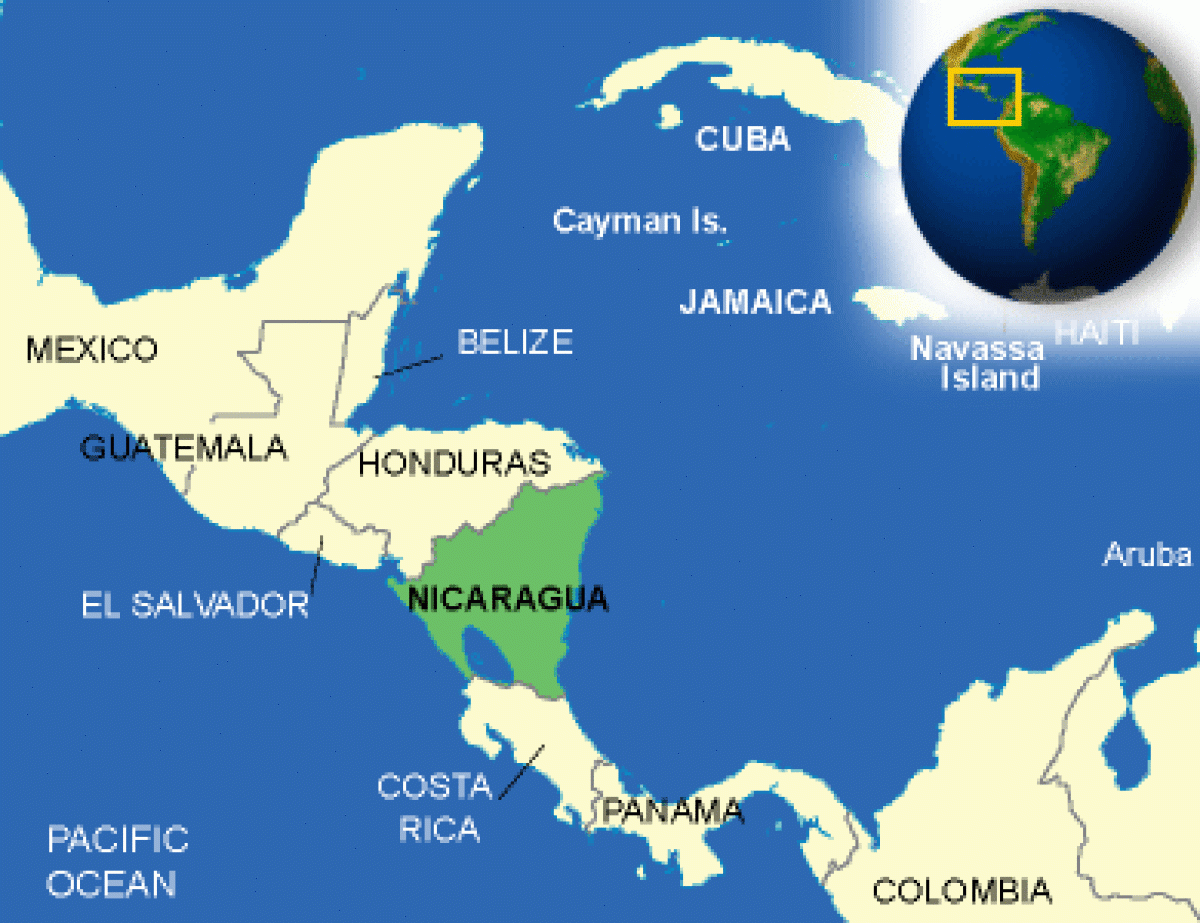
Hey y’all! So, for our first paper assignment I chose to do research on Nicaraguan Creole English (NCE) also known as Miskito Coast Creole. It is both a native and second language in rural barrios located mainly on the Eastern or Caribbean Sea coast of Nicaragua and Honduras. I first and foremost chose to research NCE because I am a Nicoya (term for a woman from Nicaragua or of Nicaraguan descent). I also chose to study NCE because I remembered visiting the region of Bluefields as a child and realizing that a form of English was being spoken but that it was unrecognizable to me. This baffled me not only because the predominant language of the country is Spanish but also because this English-lexified language was something entirely new to me.

According to the data collected by The Joshua Project, NCE is currently being spoken by less than 20,000 people in the country of Nicaragua. Born of the communication between Caribbean Coast natives, English settlers and the Miskito Indians (slaves of Jamaica and African decent), NCE is influenced by its lexifier, English, the dominant language of the country, Spanish, and other Western Caribbean creoles such as Belizean creole. NCE is a dominantly oral language, therefore many Youtube videos can be found in which it is spoken. It is not a written language and is not taught in the Nicaraguan school system, which adheres to a bilingual English to Spanish education system, making written form unlikely. The Joshua Project is rumored to be working on a biblical translation in NCE for their future missionary work in Nicaragua.

Being that this language is mainly oral and considered a subordinate language in Nicaragua, I fully expected sources on it to be scarce. I was pleasantly surprised to see that it was an academic topic that even has books dedicated to the study of NCE. I was also pleased to find that there are educational programs and global organizations working to preserve NCE and introduce the language to the digital age. The sources I found are listed below:


Angela Bartens. 2013. Nicaraguan Creole English.
In: Michaelis, Susanne Maria & Maurer, Philippe & Haspelmath, Martin & Huber, Magnus (eds.) The survey of pidgin and creole languages. Volume 1: English-based and Dutch-based languages. Oxford: Oxford University Press.


http://apics-online.info/contributions/11


MOST USEFUL SOURCE EVER. Used Barten’s work to define NCE in my paper. She has extensive research on features of the language, history of the language and sociological background. You can find even more on NCE in the survey chapter 11 linked on the top of the page once you click on the link.


Gabbert, Wolfgang, “In the Shadow of Empire – The Emergence of Afro-Creole Societies in Belize and Nicaragua,” Indiana 24 (2007): 49


http://www.jstor.org/stable/3338282?seq=1#page_scan_tab_contents


JSTOR ACCOUNT OR STUDENT LIBRARY ACCOUNT NEEDED TO ACCESS. Article on the creole societies in Nicaragua. Great source for the history of NCE and some social views on it.


http://revistas.bicu.edu.ni/index.php/wani/article/viewFile/76/76


Academic article (WRITTEN IN SPANISH) about the moving from oral creole to written creole specific to NCE. Has a ton on NCE’S morphology and syntax as well as history and social opinion on it.


Joshua Project, Frontier Ventures. (2018). Language: Nicaragua Creole English. Retrieved February 12, 2018, from https://joshuaproject.net/languages/bzk


Link to the statistics of The Joshua Project’s research of  Nicaraguan Creole English speakers (be cautious of their religious numbers and general numbers)


Keener, Andy and Decker, Kendall D. 1998. A report on the English-lexifier creole of Nicaragua, also known as Mískito Coast Creole, with special reference to Bluefields and the Corn Islands. SIL Electronic Survey Reports 2001-004.

http://citeseerx.ist.psu.edu/viewdoc/download?doi=10.1.1.579.6716&rep=rep1&type=pdf

Article written by two men who traveled to Nicaragua and recorded the language’s origin, educational status and historical and social status in Nicaragua. Great read for other references as well!


Simons, Gary F and Charles D. Fenning (eds.). 2017. Ethnologue: Languages of the World, 20th edition. Dallas, Texas: SIL International


https://www.ethnologue.com/language/bzk


Website with some statistics on NCE and the most current source I was able to find on native NCE speakers with stats provided by the United Nations


https://rising.globalvoices.org/blog/2016/05/22/strengthening-the-miskitu-and-mayangna-languages-in-nicaragua-through-digital-media/


This is a short article on new media programs in Nicaraguan upper-education schools. Students speak NCE and are allowed to create and post their own content in whichever language they choose.

Blog Post 3 Nigerian Pidgins

The reason I chose to choose Nigerian Pidgin is because of listening to Nigerian music. The Nigerian singers in Afro-Pop and Afro-Beats are often found switching between English and their native tongues. Because of a new-found love for the music I found it fitting to choose this language for the assignment. Nigerian Pidgin is spoken by 75 million speakers and is quickly growing in Nigeria. For some Nigerian Pidgin can be the first language or second language they they learn in urban areas and Southern Nigeria. The pidgin used for interethnic contact and its linguistic use has become an essential form communication for marketplaces, workplaces, and schools. The Nigerian Pidgin uses English as its lexifier and has primary Substrates in Hausa, Yoruba, and Igbo. Other contributing languages include, Benue-Kwa and other languages of the Niger-Congo family. There is a heavy usage of the English language for the pidgin where much of it is understandable to the English ear. What is also very striking is where the pidgin develops and is used. The pidgin is used in Urban areas and Southern Nigeria which is perhaps one of the more striking details of the language. The resources about my chosen language variety were not difficult to find.


Academic Sources:

Aziza, Rose Oro. “Aspects of the Syntax of Modern Nigerian Pidgin” Selected Proceedings of the 44th Annual Conference on African Linguistics, 2015, pp. 11-16.

Comrie, Bernard. “Pidgin and Creole Tense-Mood-Aspect Systems by John Victor Singler” Lanugage, Vol. 69, No. 2, 1993, pp. 389-393.

Mann, Charles. “Attitudes Toward Anglo-Nigerian Pidgin in Urban, Southern Nigeria” The Generational Variable”, 2009, pp. 349-364.

University of Hawai`I Press. “West African Pidgin English A Bibliography of Pidgin and Creole Languages”, Oceanic Linguistic Special Publication, No 14, 1975, pp. 345-360


Videos:

https://www.youtube.com/watch?v=rWe5jO7Ogwc

https://www.youtube.com/watch?v=bz_z0A2KwaM


Each source explained in some detail the Pidgin but not in the manner I expected. Finding sources and further research is required. However there is an indication of the possibility of creolization for Nigerian Pidgin.


Blog Post #3

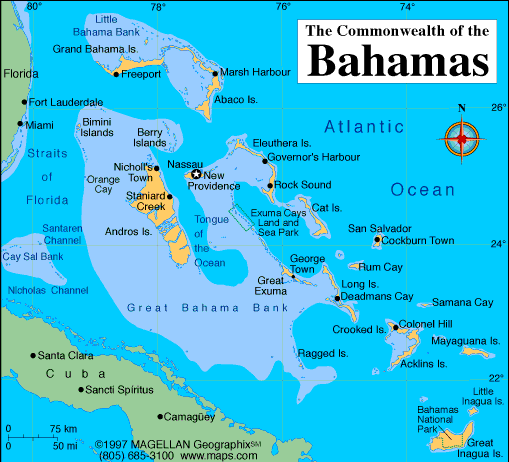
Map of Bahamas

The language I chose was the Bahamian creole. It is known in the Bahamas as the Bahamian dialect. This is an English-based creole language. 250,000 people speak it in Bahamas. This language was a mixture of Jamaican creole, and the English spoken today. Many outside influences have changed this creole into more standardized Bahamian English. I chose this language because I always thought people in the Bahamas speak English. There are several tourists who visit the Bahamas, and the workers there speak English, which is similar to how we speak it here. However, I learned that the Bahamian creole is usually looked down upon and considered to be improper. Therefore, many have learned or become accustomed to speaking the standardized language of Bahamian English. In contrast, those who speak the Bahamian creole believe it is apart of their heritage and shouldn’t be forgotten.

The resources I found were:

http://journals.sfu.ca/cob/index.php/files/article/view/124/142

This explained the differences found in the Bahamian newspapers.

Written Forms: 

https://thenassauguardian.com/

http://bahamaspress.com/

http://jonesbahamas.com/

All 3 of these newspapers use different types of written English such as the standardized Bahamian English, British English, and American English.

Spoken Form shown in this YouTube video :

https://www.youtube.com/watch?v=c6KvvyIMqWw

History of Bahamian Creole/English with explanation of word formations:

http://ufdcweb1.uflib.ufl.edu/IR00000128/00001/7j

http://clu.uni.no/icame/ij34/ICE_Age2_3.pdf

The resources were more difficult to find since there is not enough information on this language. I used the Apics website and Wikipedia which provided some sources. This helped find articles on the Bahamian creole. The outline provided helped me to research the specific questions. Once I figured out what questions I needed to focus on, it helped finding sources. However, it’s harder finding spoken forms of this Bahamian creole.

Blog Post #3

The lexified creole language I chose was Nicaraguan Creole English. The reason I picked that language variant was because I was interested in seeing what lexified creole languages existed in Spanish speaking countries. I found Nicaraguan Creole English and was instantly interested since the national language for Nicaragua is Spanish. It is mostly spoken in Bluefields, and other rural areas in Nicaragua. It’s especially spoken on the East of Nicaragua since the West is heavily dominated by Spanish speakers, and people who also speak English.

The Spoken form can be seen on various youtube videos. However, finding examples of the written language is a lot harder since it is not really a written language but instead one that is regularly spoken. The resources for my language were hard to find. I didn’t see much on academic databases and other websites. A majority of the information that was out there, was done by one person.

Below are some of the sources I used and how they were helpful to me.

Links:

http://www-01.sil.org/silesr/2001/004/SILESR2001-004.pdf

www-01.sil.org
1 A Report on the English-Lexifier Creole of Nicaragua, also known as Miskito Coast Creole, with special reference to Bluefields and the Corn Islands

-This PDF was written by two people who were well informed about the language. They wrote about the history of it, along with a general overview on it.
http://www.oxfordreference.com/view/10.1093/acref/9780192800619.001.0001/acref-9780192800619-e-787

www.oxfordreference.com
The language of the Creoles of the Miskito Coast (the Caribbean coast of Nicaragua and Honduras, named after Carib Indians

– This was the definition for my language.

https://www.youtube.com/watch?v=VzNWiSqs3B8

– Bluefields News Organization that reported in the language

www.youtube.com
Bluefields Creole News

https://www.youtube.com/watch?v=DbWcHx62fLo

-Another video where you can hear the language
https://www.youtube.com/watch?v=IwuzPT-cNQo

– A documentary on creole identity in Nicaragua

www.youtube.com
This short documentary aims to capture the factors influencing Nicaraguan Creoles to identify themselves as Black and as members of the Black diaspora.

Gullah (Blog #3 by J. Allison)

The Gullah Language

The English-lexified creole which I selected to do my paper on is Gullah (which is also called Geechee or Sea Island Creole). It is a legacy of the plantation system and its speakers are direct descendants of African slaves. I was first introduced to the existence of this language in my Black Psychology class in Spring 2017, and this stimulated my interest in the language and the Gullah people who reside primarily in the coastal areas of Georgia, South Carolina, and Northeast Florida. Furthermore, the fact that Gullah is the only English-lexified creole language spoken indigenously in the United States made me even more interested in learning about it.

Gullah is said to be similar to Bahamas Creole English and Afro-Seminole, but there are certain linguistic features particularly with tense, phonology and vocabulary that set it apart from these and other English-lexified creoles. There is no standard orthography for the language and it is predominantly an oral language used among the Gullah people and in their storytelling and music. However, it must be noted that in 2005, after 26 years, a panel of native speakers of Gullah completed the translation of the New Testament of the King James version of the Bible into Gullah, they named it De Nyew Testament: http://www.gullahbible.com/.

The Gullah people have produced various media to educate individuals about the language (and the Gullah culture) in both Gullah and English, these include the educational websites: https://www.knowitall.org/series/gullahnet, http://digital.kenyon.edu/gullah/, and https://gullahgeecheenation.com/tag/de-conch/.

There are also YouTube videos featuring Gullah story tellers such as Carolyn “Jabulile” White: https://www.youtube.com/watch?v=3kY_0lXMeVM, and Sharon Cooper Murray: https://www.youtube.com/watch?v=ijl7Sg3ZAd0.

Researchers of Gullah have also compiled resources online to educate the general public about the sociolinguistic and structural features of the language, these include: http://apics-online.info/surveys/13, https://www.ethnologue.com/language/gul, https://glc.yale.edu/gullah-rice-slavery-and-sierra-leone-american-connection, and http://academic.eb.com.york.ezproxy.cuny.edu/levels/collegiate/article/Gullah/38490.

All these resources and others about the language were easier to find than I had initially expected. However, where getting credible statistics are concerned, in terms of the total number of speakers of the language, this prove somewhat challenging as various sources gave contradictory information. Based on my findings, this may be due to the fact that there has not been any ‘proper’ official census done by the US government to count the speakers of the language since they are a marginalized group in the society and their language is considered by some to be ‘bad English,’ ‘unintelligible,’ or even not a language at all.


Sebba Chapters 1 & 2 Vocabulary

Language Convergence

  • Sometimes in situations of bilingualism, speakers change the way they speak because of the influence of other speakers’ way of speaking. If this situation persists over a long period of time, two or more languages can become more and more similar. This can affect the vocabulary, the pronunciation, or, quite often, the sentence structure and the grammar of the languages concerned. We describe this process as a “convergence” of languages.


The University of Manchester:

http://languagecontact.humanities.manchester.ac.uk/McrLC/contact/convergence.html


  • The collapsing of two languages into one resulting from the consistent spatial interaction of people with different languages.


The Pine Crest School:

http://teacherweb.ftl.pinecrest.edu/snyderd/MWH/AP/definitions/APdefinitions3.htm


Input Language


  • Input refers to the exposure learners have to authentic language in use. This can be from various sources, including the teacher, other learners, and the environment around the learners. Input can be compared to intake, which is input then taken in and internalized by the learner so it can be applied.

BBC: https://www.teachingenglish.org.uk/article/input

  • “All words, contexts, and other forms of language to which a learner is exposed, relative to acquired proficiency in first or second languages”.

Sakai, Kuniyoshi L. (2005). “Language Acquisition and Brain Development”. Science 310 (5749): 815–819. DOI:10.1126/science.1113530PMID 16272114.

Jargon

  • The technical terminology or characteristic idiom of a special activity or group.
  • a: confused unintelligible language

b : a strange, outlandish, or barbarous language or dialect

c : a hybrid language or dialect simplified in vocabulary and grammar and used for communication between peoples of different speech


Merriam-Webster Dictionary: https://www.merriam-webster.com/dictionary/jargon


https://www.ldoceonline.com/Linguistics-topic/jargon


I found it interesting that the definitions for “jargon” from the same source differed. Jargon being deemed “strange” and “barbarous” in regards to being unintelligible or used by a specific group kind of shows the influence of a dominant input language on this definition. There’s a hidden sense of properness which jargon seems to disrupt. The definition for “language convergence” provided by The University of Manchester is great. It made it easier to understand that language convergence happens over time and that multiple aspects of a language are affected. This however left me unclear about that the product of a language convergence is. Is it an entirely new language? or do the languages just become similar to each other?