Blog Post #6

For my research paper, I will be looking at the ways social media users use humor in their community, which reinforces stereotypes, but this can also, show the connection within the community. This paradoxical view of Jamaican creole can either keep the authenticity of the language, or move away from it in order to standardize the language. The outside source I will be using is “ A History of Jamaican Creole in the Jamaican Broadcasting Media” by Micheal Westphal. He states “ in language situations where two or more varieties exist coexist, the variety with the most prestige dominates… on the other hand the mass media is also a tool for to influence the language situation and it can promote a certain variety of the standard”. This is evident in the Instagram page Jamaican Twitter, where the user posts images of people talking in Jamaican creole. Although, this platform allows Jamaicans to connect and portray their language in a good way giving it a platform to be seen and viewed, it also limits the language from standardization through the ways the language is depicted. The language is depicted as being funny. The page is being used for comedic purposes, and the language being laughed at or made fun of is Jamaican creole. This reinforces the stereotypes that are associated with this creole variety.

The theoretical concepts that I will be using are decreolization, and standard and non-standard language attitudes as mentioned by John Rickford. Decreolization happens when the people who speak creole modify their language to the standard. This can happen in order to avoid stigmatization. Having said that, the Instagram users that use Patwa do not modify the language, but stigmatize the language itself by playing along with the stereotypes. One of the pictures posted by the user “jaflowergirlbahamas”, show an image of Jamaican patois words in English and in Patwa. The picture is captioned “ oh man, jokes fi days an days an extra days!!! Although, this image should be used for educational purposes such as teaching someone how to speak the language or for translation, the caption makes a mockery of it. The user reinforces the stereotypes associated with the language. On the other hand, Rickford mentions how the non-standard language attitude towards a creole shows how the creole shows a sense of solidarity, friendship, and identity. Using Jamaican creole allows the people in the community to feel a sense of belonging. They are able to communicate through it regardless of how it may look to others. They are all engaging with one another through the language.
Blog Post #6

For my research paper the analytical framework that I tend to follow is how Jamaican Creole is portrayed in social media. Whether it be comedic, news related, or for entertainment they all tend to share similarities in their form. In the article “Look Pon Likkle Chiney Gal”: Tessame Chin, The Voice, and Digital Caribbean subjects written by Tzarina T. Prater (2015) goes into depth on the numerous ways both the Jamaican language and culture is viewed on social media. Prater exemplifies the notion of “The digital Caribbean subject” when she made reference to how Tessame Chin was judged on “The voice”. Prater is describing how Chin is being portrayed on different social media outlets on her performance that was only directed towards “reggae”. This article helps to prove my argument on how Jamaicans are viewed through Facebook, YouTube, Instagram etc.

For example the following analysis is of a YouTube post by Danny and Chaddy 4ever entitled: Teaching brother Jamaican language (patois) hilarious. While scrolling through comments I came across a few viewers who disagreed with the video. Not only is the video about an older brother teaching his brother patois, it also showcased how Jamaicans tend to be viewed. Some viewers stated that the video promotes Jamaican language as incorrect english. As mentioned by viewers:“Why would you teach him to speak like that?? It’s bad english”, “why u teaching him that” shows how Jamaicans are portrayed as less intelligent and not educated due to how they speak. YouTube, Facebook, and Instagram videos/comments provides a framework that can help me analyze how Jamaicans are viewed throughout social media.

Blog Post 6

The analytical framework that I plan to use for my paper is to prove that every time people who speak Trinidadian creole teach, write or upload videos on how to speak the language variety they are legitimizing it by exposing everyone to it no matter the languages they speak.

I am arguing that the intended audience for youtubers are people who do not speak Trinidadian creole because those who speak the language will not look for instructional videos on how to speak or write the language variety.  The outside source that I chose is titled “Trinidad English Creole Orthography: Language Enregisterment and Communicative Practices in a New Media Society (2013) by Solange Anduze James. This article specifically addresses the sociolinguistic implications of orthography and how those practices deals with identities, social hierarchies and relationships to the culture. One specific quote in the article that stood out states  “Colonial officials often expressed negative views of the Creole language, often disparaging it—and its speakers—in the strongest possible terms. The recognition of Trinidad English Creole as a legitimate language has thus been slow, due in part to its sociological and ethnolinguistic association with poverty, slavery and indentured servitude”. This quote sums up some of the reasons why the language is not considered legitimate in today’s society.

Some examples from the youtube videos I have gathered are of this young man KatchKadeem who states that it is his last day in Trinidad and that he is moving to the United kingdom and before he goes he wants to teach us how to speak “trini”. It can be said that the physical space means authenticity to him. The fact that he wants to teach before he leaves Trinidad means that being in that space gives him more credibility. As with all people who migrate to another country, acculturation takes place and cultures mesh and for this young man he is avoiding this aspect by making these videos when he is on his native land.

This young man provides words in Trinidadian creole and provides the way that it would be said in standard English such as

MACO: A gossip, a person who likes to mind the business of others, easedropper.    A saying in Trinidad :  if youre going to maco, maco properly— He provides sayings unique to his culture to give us a better understand to the language variety.

Skin up- no way it can be said in standard English but he used it in a sentence to explain the meaning.

Suck eye- means something is very easy.

KatchKadeem also explains that Trinidadian creole English words are shortened and provides examples of how certain words would be translated in Trini

There= dere

They =dey

The = d/de

Blog Post 6

For our research paper I reframed and narrowed my questions to the following: How is Jamaican Creole represented on social media and what is its audience’s response? Does the language have any authenticity and does the audience acknowledge that?
How do people outside of the Jamaican culture respond to Jamaican Creole? The outside source I chose for this post comes from Alicia Beckford Wassink’s “Historic low prestige and seeds of change: Attitudes toward Jamaican Creole.” Based on data that Wassink collected she found out that people are “willing to call JC a ‘language’ with its own regional varieties – a language variety distinct from English, on the basis of perceived differences primarily in phonology and lexicon” (81). Her data also reveals that younger people (ages 20-45) make the distinction between slang and Jamaican Creole. This implies that within the younger generations people have become more accepting of the Creole and have realized it is its own language with its own unique characteristics. This ties in with the data I found on YouTube.

Throughout the social media site there are several videos of people teaching their audiences how to speak Jamaican Creole or Patois. In HelloBianca’s WHITE BOYFRIEND LEARNS JAMAICAN PATOIS/SLANG !! (CRINGY)” she is seen teaching her boyfriend how to pronounce some phrases such as “Wah Gwan,” “Mi ago a bashment tonight” etc… The boyfriend not only has to repeat the phrase, but also has to guess what he thinks it means. One phrase that her audience strongly disagreed with was “Him naah behave.” The boyfriend thought it meant “He is not behaving,” to which she replied “You’re wrong! It’s basically like when someone looks good. So let’s say you stuntin with your nice outfit and then someone’s like ‘him naah behave! Like you look good, you’re going off.” She also states that him doesn’t mean a guy it’s really “im.” Her explanation of this phrase, as well as pronounciation of other phrases, and even spelling, caused many people to comment things like “…your explanations are weak and lacking in authencity,” “You don’t spell your Patwa correctly,” “Yuh nuh ready yet trust mi… dem accent deh nuh ready trus mi… depand??? What the hell… poor thing… she sounds funny,” and “wow misleading info… them need fi do more reasearch… very good idea for a vlog… the presentation is off… n it’s not mi nah romp… it’s mi nah RAMP…” The people commenting appeared to have some consensus about what authentic Patois is and what it’s not. This ties into Wassink’s findings because people are acknowledging that Jamaican Creole/Patois has a set of rules about what things mean and some kind of consensus on spelling. This essentially means that people (at least the people among the comment section) acknowledge it as a real language.

Blog #6

For my project on Jamaican Creole orthography and attitudes towards the language in social media, I will be applying some concepts of Historic low prestige and seeds of change: Attitudes toward Jamaican Creole by Alicia Beckford Wassink. Some of the concepts I will be using are mainly focused on the attitude toward JC, since I am having a little trouble finding articles to shape my argument for the standardization of its orthography through memes.

The article goes in depth with discussing the attitudes toward the Jamaican Creole language. It first discusses how Jamaican Creole was seen as a low prestige language, and then how it has actually gained prestige. It also talks about how native speakers of language feel towards the language, and who they think should be able to use the language.

The article states:

Recent discussion among both Jamaican scholars and laypeople suggests that Jamaicans’ attitudes toward Jamaican Creole (hereafter JC) are changing.’ This change, some suggest, has accompanied the increased popularity of Dancehall culture and nationalistic ‘consciousness raising’ efforts (Christie 1995, Shields- Brodber 1997).2,

(57).

Here, the article suggests that Jamaica Creole has risen in popularity due to Dancehall culture and other efforts of mixed media. The article later goes on to say: “ Such a shift in attitudes toward “things Jamaican” marks a significant conceptual reorientation, in light of the high esteem that historically has been given to British culture, and more recently on American culture,” (57). These types of shifts in the popularity and prestige in the language allow for many people all over the internet to police the language, even when they may not be Jamaican Creole speakers themselves (since it has quickly become a popular language throughout the world).

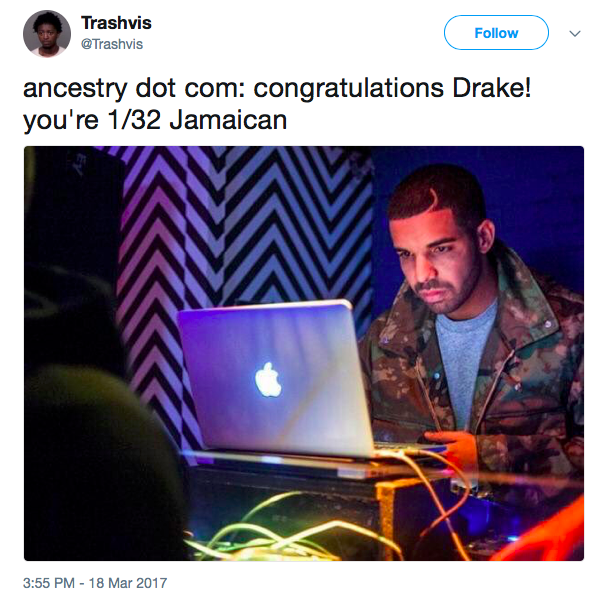
For the meme in my featured image it shows a picture of the Canadian Rapper Drake, checking a laptop. The caption for the meme is “ancestry dot com: congratulations Drake! you’re 1/32 Jamaican.” While it is unknown whether or not the creator of the meme is actually a native Jamaican Creole speaker, the meme creator does police who can and cannot use the language with the meme. It calls into question the authenticity of Drake’s continued use of Jamaican Creole in his music. The creator of the meme feels that since Drake is not of Jamaican descent, he shouldn’t be allowed to use the language. This is why he makes Drake have a tiny bit of Jamaican in him with the meme going hand and hand with the website ancestry.com. It also makes fun of the fact that people do ancestry tests, and end up with small percentages of heritage they never thought they would be apart of. So, it makes fun of the rapper and shuns him for using a language that is part of a culture/heritage he is not apart of.

Many of the comments and reactions to the post on twitter also police Drake’s use of JC. There are comments such as this one: 

Here, one of the commenters, Miguelmeza23, makes fun of Drake with their own meme-like comment. The comment has a caption that says “Drake be like,” and shows a picture of a man wearing a Rastacap saying “If I wasn’t Jamaican, then why would I wear this hat?” It not only makes fun of the rapper for using JC, but also shows how he is in a way, appropriating the culture for financial gain and prominence among the Jamaican community. However, even with all the jokes it can be argued that the rapper Drake is in fact, helping the language gain prestige. He mingles in circles of money and power, and has become an international and national icon. The fact that he uses Jamaican Creole in his music and opens up a dialogue about the language, shows how he forces people all throughout the internet (and world) to think about the language.

Drake’s manipulation of “the digital Caribbean subject” and the “digital diaspora”

In the article “Look Pon Likkle Chiney Gal”: Tessanne Chin, The Voice, and Digital Caribbean Subjects”, author Tzarina Prater (2015) speaks of the fetishization of Jamaican culture and language by mass culture. Prater’s discussion of the “digital diaspora” is vital to my research on attitudes towards rap artist Drake’s constant usage of Jamaican Patwa in his music and social media postings. Prater goes in depth about the digital diaspora using Brinkerhoff’s definition of it being “an explicitly political project in which diasporic subjects use digital platforms to express diasporic consciousness and articulate complex hybrid identities formed in and through diasporic practices and processes to negotiate the terms of identity, share experiences of inclusion, exclusion, generational conflict, strategies for navigating political, economic and social quagmires in their host nation as well as virtual spaces along with fostering and retaining cultural and political connections through linkages to “home” (6). Prater provides a framework that can help me analyze not only why Drake’s language usage goes viral but also what kinds of attitudes it might generate. She speaks about the “digital Caribbean subject” and how they must constantly have to fight the imperialistic morphing of their identities and culture, however, this has me thinking about how the “diasporic subject” can manipulate this space and use it for personal clout gain

“As a true yaadi mi cringe at dis.”  – comment by Tron Whitfield made on a YouTube video titled “Drake ‘is tired of people saying he isn’t Jamaican”:

27 likes

The video is a small compilation of videos on Drake’s snapchat in which he is constantly code switching between Standard English and Jamaican Patwa when expressing discontent. He saliently does so when speaking about not being able to fly into England for a festival performance, switching into Patwa when stating that he doesn’t care about why he could not and did so anyway. In other portions of the video, he uses some Patwa words when engaging with certain groups of people. Drake seems to embody Prater’s idea of the “digital Caribbean subject” and takes on the criticism that she believes digital media consumers deal, however, Drake is being called out for being identifiable with the imperialistic model of “caribeaness”. Tron Whitfield’s comment questions Drake’s cultural authenticity, especially because he is not of Jamaican descent or as Whitfield puts it, “a true yaadi”. Drake is furthermore identified as a “culture vulture” (user: Damien Henson). His usage of Patwa creates an entirely new identity that in some ways does take on imperialistic influence on “caribbeaness”. For example, exposing his millions of fans and followers to the language, however, his constant misusage of the language makes it seem like an identity one can simply take on, especially if it warrants some positive attention.

Jamaican Creole as “The Digital Caribbean Subject” in Social media (Blog #6)

Tzarina T. Prater’s article entitled “Look Pon Likkle Chiney Gal”: Tessanne Chin, The Voice, and Digital Caribbean Subjects” presents concepts that are very relevant to my research which focuses on analyzing data that shows how Jamaican Creole is exoticized in social media. Prater illustrates the concept of “the digital Caribbean subject” which can be defined as the individual from Caribbean culture who is on display in the digital domain and who is critiqued and valued based on their “caribbeanness” through their appearance and linguistic performance.

Prater uses the concept of “the digital Caribbean subject” in her reference to how Tessanne Chin (“the subject”) was exoticized on The Voice by the judges, and to a wider extent by the public via YouTube and other forms of social media (the “digital domain”). She further discusses the “fetishizing of Caribbeanness” which was reflected in the songs chosen for Tessanne to sing which were mostly reggae, and describes Tessanne’s performance as the “caribbeanness” and  “otherness” demanded by “these armchair tourists.” In general, Prater is describing how this Caribbean subject was being exoticized by these judges and others outside of the Jamaican culture through her linguistic performance and by extension her ethnicity. This is similar to how Jamaican Creole and the performers of this language are exoticized on Twitter and YouTube in the research that I am conducting.

For example:

The following analysis is of a twitter post by Joedi who is from Tallahassee, United States:

I need a Jamaican gyal to speak patois in ear right now and tell me how much my voice makes her moist (@officialjoedi_, 5:12 PM – 31 Mar 2018)

In this example, we see how the Jamaican woman (or “Jamaican gyal”) is not the only subject being exoticized (and even sexualized) in this digital medium, Twitter, but more-over the Jamaican Creole (or “patois”) that this American, Joedi, claims he desires for her to speak in his ear. She is fetishized as this exotic creature whose language and ethnicity renders her unusual and submissive to Joedi who claims he wants her to tell him “how much [his] voice makes her moist.”  The fact that she is unnamed further reinforces my view that this is possibly Joedi’s general ideology of Jamaican women as being exotic beings who speak an exotic language that he likes to hear.


The following analysis is of a YouTube video by AwesomeAlanna (2014) who is Australian:

The video is entitled “How to Do A Jamaican Accent” and presents Jamaican Creole and the Jamaican accent as the “digital Caribbean subject” being exoticized by AwesomeAlanna who is Australian and white. In the video, AwesomeAlanna wears a wig made of dreadlocks suggesting that she is “in tune with the Jamaican culture” and does the Jamaican Creole tutorial in her thick Australian accent while at times stopping to explain at what points she is doing a Jamaican accent. She states that the most used word in Jamaican Creole is “mon” and says that “it works for everything, man, woman, child, thing…everything is mon.” She further exoticizes this Caribbean subject through this digital medium by stating that “apparently, because we [as in herself and Jamaicans] are so laid back and chilled, we…drop the last letters in words.” Further in the video, the “we” becomes “they” (which suggests “otherness”) when she states that “apparently they [Jamaicans] talk in present tense when referring to the past.”  She then ends the video by exclaiming with great pride how “chill” the language is and then she sings the chorus of Rihanna’s “Pon de Replay.” Her performance of this chorus from the song suggests that she generally views Caribbeanness and Jamaican Creole as something very exotic, because even though “pon de replay” may sound like Jamaican Creole, Rihanna is Bajan.

I am not surprised that she disabled the comments section of this video. This indirectly illustrates the depth of her apprehensions where the comments of the public in this digital domain about how she presents this Caribbean subject is concerned.


Blog Post 6

In the article, Identity and Language attitude among Liberian refugees in Oru camp,ogun State, Nigeria by Dr. Nwagbu, Osita Gerald the (1) analytical framework are Identity and Language attitude.

(1) Identity represent an individual’s perception of himself irrespective of the way he is perceived by (Berry,2008) this perception ranges from the personal to the social and ethic.

Giles (1977) note that language is not just an instrument for the exchange of message, but serves as a means of distinguishing a group from other groups.

Anderson (1975, cited in Korth 2005:23) define language attitude as “thiinking, feeling, and reacting with regard to people, objects, social groups or events.” This behavior could be positive or negative, favorable or unfavorable.

In the article the study of the proficiency to speak their indigenous language language was taken on three on three age demographic teens, young adult, elderly and it was found that in the youngest age bracket, the ability to speak the language was low. Whereas in the higher age demographic, the proficiency to speak the language was in at a higher level. This is due to the negativity surrounding the language and the people with speak it. The younger generations wanted to avoid any association, therefore knowing how to speak the language well was not a priority.  it was a little different in regards to speaking Yoruba. Since, the people speaking this is regarded in a more positive light, even he teenagers spoke it more fluidly. There was however these who didn’t speak it well but this was more due to English being spoken (that they spoke as well) than any negativity towards the people and the language. I think this goes against what I’m doing for my research because not only is there a fluency in speaking the indigenous language NC ( in the young as well as the old) but they use the language to play up the negative stereotypes surrounding it, using humorous skits to combat it. In this in your face way, they show the ridiculousness of these stereotypes, and at the same time expose the talents of individuals. This in itself a positive because it has opened doors, such as the success of an International comedy company (Mark Angel Comedy)  , a feature in a Disney movie (8 year old Emmanuella), a rising star famous for videos of his comments on social media (Akah Nnani) and Nigeria Top purveyors of gist online (Osagie Alonge).

(2) Data Analysis

…they no like us, that is why I no speak their language. They insult us because we are not their people (Mummy favour)

….It is good to learn Yoruba because we are staying in their land and the integration matter, but the way they take us is not good (popei)

…..I would have loved to learn Yoruba but you see, we all understand English…..if they didn’t speak English then I will force myself and learn Yoruba because of communication (Kennedy).


Blog Post 5

For the final Research Project I’m going to focus on Nigerian Creole from an sociolinguistic approach like Heyd. I will be looking at the language and identity attitudes toward Nigerian creole on social media like instagram, twitter, and youtube. I also will be focusing on how idea that even though Creole languages still faces negativity like stereotypes, stigmas, exoticism, etc Nigerian Creole has still gained a lot of attention and awareness regardless of these negativity.

Questions:

What are people thinking and feeling after viewing these comedy skits?

What are driving the viewer to watch these comedy skit? Could exoticism be playing a part?

Does making these humorous video/skit around the Nigerian culture help or hurt them in the end?

Overstanding Idren: Special Features of Rasta Talk Morphology by Benjamin Slade

Vocabulary

  • Overstandings are based on

–  Perceived morphological analysis on the word

–   Switching of an element standing in a binary opposition to the other member of the  opposition in accordance to perceived positive/negative connotations of the words (5).


  • Folk Etymology: Change in the form of a word based on misunderstanding or unfamiliarity of a speaker with one or more of its components (3).


  • Word-Sound-Power:
  • The shared experience of sound quality, the agency and spiritual potential of a speaker, and the   collective resistance against linguistic forms imposed by colonial rule’ (Bean 2014: 49).


  • Iformation: Diachronic evolution of I-words and the process that creates them (4).


Rasta Talk (AKA: Dread Talk, Iyaric, Livalect etc)

Pollard (2000) identifies Rasta Talk as different from Jamaican Creole as well as other forms of English due to its features. She does so by analyzing the lexical and morphological features of the language and creating three categories into which they fit:


Category I: Known items bear new meanings

Category II: Words whose phonology bear/are made to bear the weight of their phonological implication

Category III: ‘/ai/’ Words

(Slade focuses on Category II and III words for the purposes of this article)


Category II – Overstandings

  • Purpose of overstandings: To provide corrective forms with the same core meanings as the base (9).
  •  Overstand corrects the negative connotations that ‘understand’ carries

         Last night implies one’s literal last night – end of existence (9). It then becomes First      night.

          Wisdom implies someone is dumb. It becomes wisemind.

  • Different from folk etymolgy.
  • The constraint on the resulting form is that the perceived semantics of the component pieces of morphology have to bear a compositional relationship to the perceived semantics of the word as a whole (7).

           Example: “Understanding”

           Under  (Negative connotations – lesser, below ) + Stand = Lesser Comprehension

           Transformation: Overstanding

           Over (Positive connotation – higher) + Stand = Higher Comprehension

           Overstand matches the meaning

  • Recent overstanding: Fulljoy (enjoy – end+joy) but Startjoy is a better example of an overstanding because start replaces the negative connotation.
  • The transformations are flips of elements in binary oppositions (7) (ex under/over, down/up, out/in, love/hate etc…)

Examples

           Downpress as opposed to oppress (Sounds like Uppress)

           Apprecilove as opposed to appreciate (Sounds like Apprecihate)

  Used in a sentence: Ras Mandingo, you original question puts a serious limitation pon the overstanding of Rastafari. Cause Rasta a not no ‘organ- ized religious faith’ like some church denomination.

  •  Overstandings resemble puns/wordplay but they are not. Puns depend on a word having two different meanings whereas overstandings do not. Overstandings replace the original source (11).

Ex of a pun:

Now is the winter of our discontent Made glorious summer by this son of York [W. Shakespeare, Richard III, I.i.1-2]

Son means literal someone’s son and the sun

Category III I-Words and I Formation

  • According to Schrenk (2016) Iformation occurs when:
  1. The word has a morphological component with a negative association (usually as a prefix), in which case Iformation may apply eliminating this component
  2. the speaker desires to make an already positively-associated word (which has no disharmonious morphological elements) more clearly positively-associated
  • A replacement of the word’s initial syllable to ‘I’ (19)

               Unity → Inity /ainity/

  • Sometimes replaces the word’s initial syllable regardless of the base word being vowel initial

           Deserve → Iserve

  • Not restricted morphologically or phonologically
  • For monosyllabic words the first segment is replaced by y.

              Food → Yood /jud/

              Life → Yife /jaife/

  • Jamaican Creole ‘mi’ is replaced with IandI (IanI), or I
  • Second person forms are replaced less frequently

           Ex King James biblical pronoun thy can coexist with I replaced forms for ‘you’: Glad to see the IMan thriving and studying to show Thyself approved unto Jah

  • Used in a sentence:

           /ai man a faawod/

           I am leaving now

  • Early I-words involved vowel to vowel transformations

           Ex: Equalty → Iquality

                  Ancient → Icient

  • I-transformations have little effect to semantics of the word.
  • I-transformations can also be applied to words that that are considered overstandings

           Iverstanding → Overstanding

  • Like overstandings, I-transformations sometimes work to eliminate negative connotations

           Praises (prey+ses) → Ises

Discussion Questions

  1. How does ‘Rasta Talk’ work for/against Jamaican Creole?


  1. How does its role in Jamaican Creole differ from slang’s role in Standard English?
