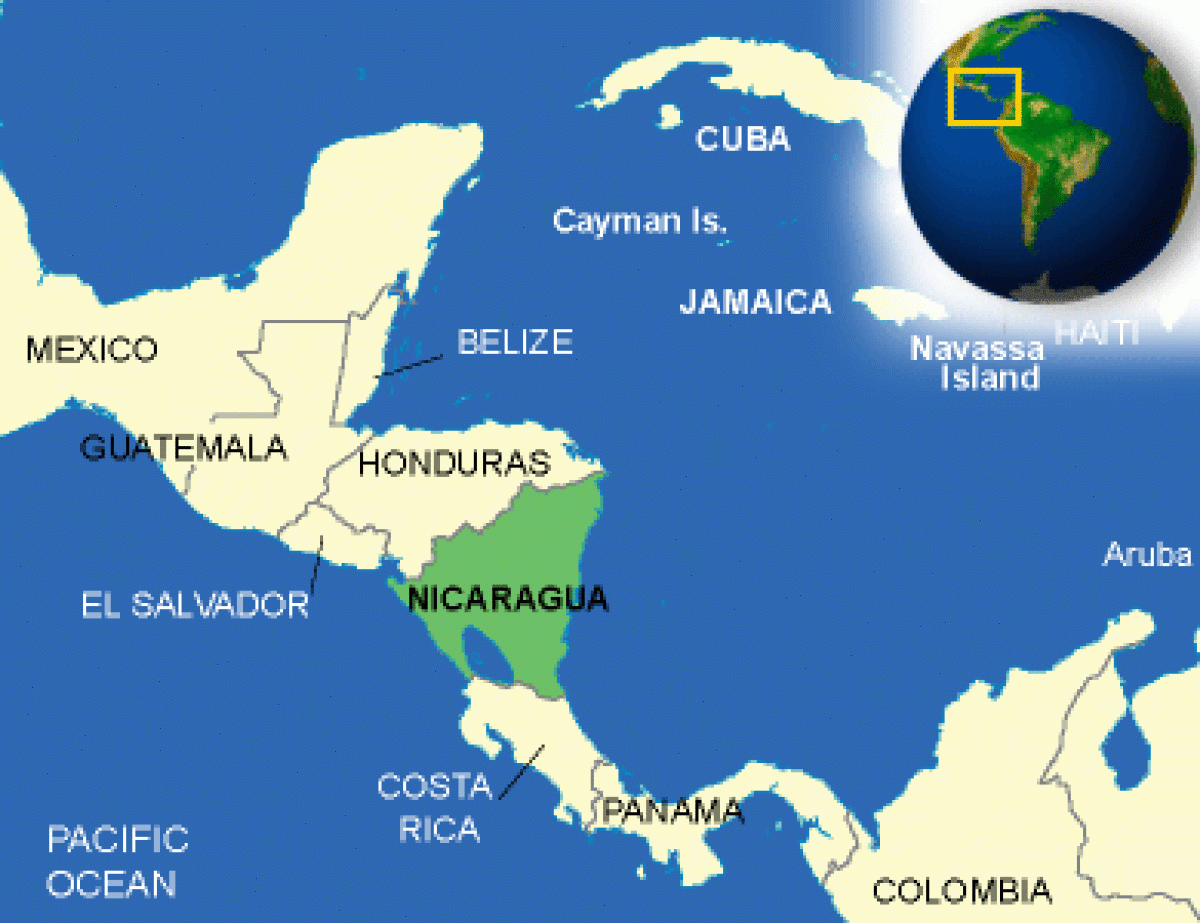
Hey y’all! So, for our first paper assignment I chose to do research on Nicaraguan Creole English (NCE) also known as Miskito Coast Creole. It is both a native and second language in rural barrios located mainly on the Eastern or Caribbean Sea coast of Nicaragua and Honduras. I first and foremost chose to research NCE because I am a Nicoya (term for a woman from Nicaragua or of Nicaraguan descent). I also chose to study NCE because I remembered visiting the region of Bluefields as a child and realizing that a form of English was being spoken but that it was unrecognizable to me. This baffled me not only because the predominant language of the country is Spanish but also because this English-lexified language was something entirely new to me.
According to the data collected by The Joshua Project, NCE is currently being spoken by less than 20,000 people in the country of Nicaragua. Born of the communication between Caribbean Coast natives, English settlers and the Miskito Indians (slaves of Jamaica and African decent), NCE is influenced by its lexifier, English, the dominant language of the country, Spanish, and other Western Caribbean creoles such as Belizean creole. NCE is a dominantly oral language, therefore many Youtube videos can be found in which it is spoken. It is not a written language and is not taught in the Nicaraguan school system, which adheres to a bilingual English to Spanish education system, making written form unlikely. The Joshua Project is rumored to be working on a biblical translation in NCE for their future missionary work in Nicaragua.
Being that this language is mainly oral and considered a subordinate language in Nicaragua, I fully expected sources on it to be scarce. I was pleasantly surprised to see that it was an academic topic that even has books dedicated to the study of NCE. I was also pleased to find that there are educational programs and global organizations working to preserve NCE and introduce the language to the digital age. The sources I found are listed below:
Angela Bartens. 2013. Nicaraguan Creole English.
In: Michaelis, Susanne Maria & Maurer, Philippe & Haspelmath, Martin & Huber, Magnus (eds.) The survey of pidgin and creole languages. Volume 1: English-based and Dutch-based languages. Oxford: Oxford University Press.
http://apics-online.info/contributions/11
MOST USEFUL SOURCE EVER. Used Barten’s work to define NCE in my paper. She has extensive research on features of the language, history of the language and sociological background. You can find even more on NCE in the survey chapter 11 linked on the top of the page once you click on the link.
Gabbert, Wolfgang, “In the Shadow of Empire – The Emergence of Afro-Creole Societies in Belize and Nicaragua,” Indiana 24 (2007): 49
http://www.jstor.org/stable/3338282?seq=1#page_scan_tab_contents
JSTOR ACCOUNT OR STUDENT LIBRARY ACCOUNT NEEDED TO ACCESS. Article on the creole societies in Nicaragua. Great source for the history of NCE and some social views on it.
http://revistas.bicu.edu.ni/index.php/wani/article/viewFile/76/76
Academic article (WRITTEN IN SPANISH) about the moving from oral creole to written creole specific to NCE. Has a ton on NCE’S morphology and syntax as well as history and social opinion on it.
Joshua Project, Frontier Ventures. (2018). Language: Nicaragua Creole English. Retrieved February 12, 2018, from https://joshuaproject.net/languages/bzk
Link to the statistics of The Joshua Project’s research of Nicaraguan Creole English speakers (be cautious of their religious numbers and general numbers)
Keener, Andy and Decker, Kendall D. 1998. A report on the English-lexifier creole of Nicaragua, also known as Mískito Coast Creole, with special reference to Bluefields and the Corn Islands. SIL Electronic Survey Reports 2001-004.
http://citeseerx.ist.psu.edu/viewdoc/download?doi=10.1.1.579.6716&rep=rep1&type=pdf
Article written by two men who traveled to Nicaragua and recorded the language’s origin, educational status and historical and social status in Nicaragua. Great read for other references as well!
Simons, Gary F and Charles D. Fenning (eds.). 2017. Ethnologue: Languages of the World, 20th edition. Dallas, Texas: SIL International
https://www.ethnologue.com/language/bzk
Website with some statistics on NCE and the most current source I was able to find on native NCE speakers with stats provided by the United Nations
https://rising.globalvoices.org/blog/2016/05/22/strengthening-the-miskitu-and-mayangna-languages-in-nicaragua-through-digital-media/
This is a short article on new media programs in Nicaraguan upper-education schools. Students speak NCE and are allowed to create and post their own content in whichever language they choose.