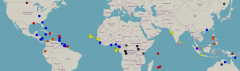
I think the class was great. Despite attendance I did manage to do 90 percent of the readings and they were more difficult than the Introductory course. There was so much more detail in terms of terminology and the function of language. I felt as though, that despite having theoretical elements this linguistics course was very technical in the research. The readings I encountered had statistics, phrases, and elements of the phonetic alphabet I didn’t understand. It was during the first paper I understood it would require more effort and attention in writing the papers. I found the first paper to be very difficult to scratch past the basic surface level of Nigerian Pidgin and the basic information about it. However, with assignment two, we addressed literature that was much more intriguing than our regular readings, which were not always intriguing. The literature was interesting because we got to address Creole in form. What I was able to address was the morphosyntax and orthography or creole. My aim was to address the authenticity of both within the writing of Caribbean authors. I was able to get more technical using phonetic sounds to and parts of the mouth to identify why specific words were pronounced the way they are and how they came to be. Finally, I think the final assignment has been the most challenging writing process I have engaged in. Originally, I wanted to do Gurundji Kriol as the focus of my paper but its sample size and presence within Australia is too little as it only has 1000 speakers. However, I did manage to find more information Australian Kriol and will take on an interesting perspective in how media, movies, interviews, and writing separate the AE and AK speakers what the social perspectives will be for both. It should be interesting to see an analysis of the television series Clever Man as the basis for the research.
Author: Jamaar A. Watson
Blog Post 6
The analytical framework I intend to use is using the morphology of the assignment and the phonetic differences in the language. What I intend to use is the movie in addition to other media sources to examine the phonetic differences in Australian English and Australian Kreole. In addition to the citation of sources, the main focus will be using the research to asses and analyze spoken word and the attitudes about them. So, the Netflix series Cleverman which is spoken mostly in Australian English introduces a number of characters who speak and move along the continuum between AE and AK. For example, “Brainwash from English”? Barunga Kriol Speakers’ Views on Their Own Language” by MaÏa Ponsonnet is pertinent to my evaluation of the show in several aspects. It addresses the “brainwashing” and “segregation” of the Australian Kriol speakers and the push to have them become more English and shy away from Indigenous culture including language and customs which rely heavily on unique language of the substrate languages. An assessment of this as I address the politics, language and will be pertinent to my project.
For Example:
Even within this video the speaker is attempting to speak fully through in Australian English until the end of the video where there is only a small portion of it where she interacts in Australian Kriol.
Analysis of her speech would reflect the articles translations. So, upon listening and distinguishing what is being said it would look different from the written form of English as well.
(2) [MT, speaking Dalabon]
[Wurdurd-ngan], wadjbala bulnu kah-didjim
‘[My son] used to teach all these white people’
Blog Post 5
Blog Post 5:
For my final project I expect to analyze Australian Creole and its usage within social media. The intention of this is to figure out how much it is actually used in comparison to Standard Australian English. There will be an analysis of video, observation of two individuals who are Australian and the attempt to figure out the evolution of Australian Creole and the attitudes towards it. Originally It was intended for me to examine Gurindji Kriol language, but the sample size was too small. However, there is a key similarity in how indigenous languages are disappearing and how Australian Kriol its lexifier English, borrows and merges many elements of the indigenous language. There are TV shows such and Clever Man which induce this in their script and examining that would give insight to how much the Australian population accepts Kriol as a standard of speaking. I believe drawing from a sociolinguistic approach like Heyd to compose this final project.
Has Australian Kriol made its way into being a language of equal use in comparison to Standard Australian English and if it has, does it reflect a diverse language community and an acceptance of it?
Does the Australian culture allow for this diversity of language to thrive in Television and other forms of creative entertainment?
Is there an innate separation of speakers in creative Australian entertainment where one speaker is deemed more civilized than the other in contrast to Australia Kriol (spoken by indigenous looking characters) v. Standard Australian English (spoken by characters that resemble the colonizer)?
Blog Post 2
Agglutinating: According the Summer Institute of Linguistics, an Agglutinative language is a language in which words are made up of a linear sequence of distinct morphemes and each component of meaning is represented by its own morpheme.
(SIL Glossary Terms) https://glossary.sil.org/term/agglutinative-language
Inflectional Morphology: Inflectional morphology is the study of the processes, such as affixation and vowel change that distinguish forms of word in certain grammatical categories.
(Gregor Stump, Oxford Research Encyclopedias)
Derivational Morphology: A type of word formation that creates new lexemes either by changing syntactic category or adding substantial new meaning to a free or bound base. (examples of this include adding -ness or un in the prefix or suffix.
(Rochelle Lieber, Oxford Research Encyclopedia of Linguistics)
I think that the definition that is most complete was the definition Derivational Morphology. comes from the Oxford Research Encyclopedia of Linguistics. In finding the definition I was able to view an entire article in relation to the term, that was solely dedicated to how it is used, its features. It provided a plethora of information for defining derivation and showing examples in how the term happens within language in detail. These terms and their usages are documented and explained by specific authors which may have been the reason I understood this definition better than the other two unfamiliar words. It may be authorship and how each article is composed for the term. The Oxford Research Encyclopedia of Linguistics proved to be very detailed, as I expected just a definition but I received the definition and a lengthy article on the term.
Essay 2
Jamaar Watson
Dr. Garley
English 470: Pidgins and Creoles
3/29/2018
Writing So and Talking So: A Sociolinguistic Analysis Trinidadian and Guyanese Literature
“Language has always been the consort o empire and shall forever remain its mate. Together the come into being, together they grow and flower and together they decline.” (Sebba, 7). Despite being culturally sufficient pidgins and creoles are disregarded and considered to be lesser forms of language. The effects are most evident within post-colonial nations such as those in the Caribbean where authors especially in their writing attempt to retain genuine elements of Caribbean creole in the orthography and morphosyntax. Authors Earl Lovelace and Eric Walrond are both Caribbean authors who write short stories crafting the Caribbean experience. Joebell & America” by Lovelace and “Drought” by Walrond are prominent pieces are written using the acrolectal forms of English with attempts to pay ode to their Caribbean heritage. Lovelace’s narrates a Caribbean man attempting to replicate American ideology through language and behavior using the morphosyntax of TEC. However, his command over TEC’s orthography the is miniscule. Walrond uses orthographic elements of GEC and SE’s morphosyntax as he romanticizes drought in Guyana. Both authors have succumbed to quell the systematic beast that is the imperialistic standard of SE. In doing this the authors have vandalized the Caribbean English creoles language culture, as they replace key orthographic and morphosyntatic elements. This happens not because the authors lack ingenuity or aptitude in understanding their culture, but unjust language conditioning that teaches SE is a necessity in political correctness and global acceptance.
The composition of “Joebell & America” by Lovelace within his narrative shy’s away from the orthography of Trinidadian Creole. The usage of TEC has an extensive vocabulary unique to the region which Lovelace does command this within his tale. This diglossia is apparent in the use of TEC morphosyntax and the lack of the creolized vocabulary. Lovelace uses STE to write his narrative as he leans away from the conventional spellings of the TEC. Within STE, the spelling of words is the same as that of SE. Lovelace’s form throughout the text sticks to STE as there is little ode paid to the rich culture of the TEC. For example, the words the, saysand enoughare known to be spelled differently when examining STE and TEC as two separate entities. According to Solange Anduze James in her piece “Trinidad English Creole Orthography: Language Enregisterment and Communicative Practices in a New Media Society” she notes that “Examples commonly used in English include sez for the word ‘says’ and enuff for the word ‘enough’.” (James, 31). Lovelace’s text does not employ the shift in spelling throughout his text as he consistently uses STE spelling for words. It may be acceptable within the narrative to use STE to narrate but he retains the usage of STE within dialogue. This seems to counteract the authenticity and veneration in regard to TEC and its speakers. For example, Lovelace writes “And I smile ’cause I see enough war pictures to know. “Nor’Carolina,” I say.” (Lovelace). The text lacks the TEC form of the word enough consistently as the characters native to the island who are expected to be speaking TEC are using STE and saying enoughinstead of enuff. Other examples include the word ‘says’ which is absent in the plural form within the text in both STE and TEC, as well as its TEC spelling, sez. Furthermore, words such as theoccurs often. In realizing such heavy usage of the, there are several realizations when the TEC version is not used other than the lack of staying true to TEC orthography. James writes that “The copula or forms of ‘to be’ are usually absent and are generally deleted after pronouns, for example, /di bwai dɛm wrkrd/ “De boy dem wicked” (TEC) ‘The boys are very wicked or mischievous’ (STE)” (James, 13). There is an obvious difference in the orthography of the in STE and de inTEC. The difference in spelling the words theand dealso cause phonetic shifts in the pronunciation. The would be pronounced with the dental stop being a major part of its pronunciation, as the tongue hits the upper teeth. De on the other hand utilizes the alveolar ridge to pronounce the d, which also gives birth to the sing “songish” pronunciation of both the d paired with e in the TEC. Despite there being a lack of TEC orthography Lovelace does accurately use TEC morphosyntax in the composition of sentences. Lovelace writes “But, a couple years earlier, Joebell make prison for a wounding, and before that they had him up for resisting arrest and using obscene language.” (Lovelace). The grammatical rules of TEC can be identified in the usage of make. The perfective past according to Michaelis et. al is a key feature of TEC.The tense usage aligns with the morphosyntax of the creole. Another instance is described by Shondel Nero who says,“Another grammatical feature in CE speaker’s use of the modal would, where in many cases Americans would say will” (Nero, 4). Lovelace’s writing does the opposite, as he uses will to indicate the future tense instead of would. Lovelace writes “If Joebell don’t go to America now, he will never go again.” (Lovelace). It is clear that Lovelace does not command the orthography of the language as expected TEC should, and despite using TEC’s morphosyntax there are inconsistencies within that element as well.
Coupled with Eric Walronds text there is a drastic difference between the two in how they devalue the Caribbean creole. Walrond’s narrative “Drought” possesses very little creolized morphosyntax. GEC morphosyntax was very difficult to find except in rare instances of Walrond using GEC orthography. Perhaps it is in the composition of the characters where Walrond attempts to strike balance as he too appeases to the language of the colonizer within his narrative. Because of the use of very romanticized Standard English, it can be assumed Walrond was writing in this fashion in order for the writing to gain acceptance by the prestigious SE speaking community. For example, Walrond writes “Hunger – pricks at stomach inured to brackish coffee and cassava pone – pressed on folk, joyful as rabbits in a grassy ravine, wrenching themselves free of the lure of the white earth”. (Walrond, 26). What can be analyzed is the choice that Walrond’s text provides no subversion to the traditional forms of writing and does not allow his Caribbean literature to exist as a unique authentic cannon. There is very little usage of the grammatical features of the creole unless he is using dialogue which entails a separation of the narrative and characters as two separate independent entities outside of a Caribbean whole. According Muhammad Raji Zughol there may be the pressure of the driving force of “hegemonic and imperialistic” natures and “English is unilateral in vision and it forms a real threat to other languages and cultures”. In appeasing to the imperialistic SE system for acceptance Walronds methods confirms Zughol’s ideology in “Globalization and EFL/ESL Pedagogy in the Arab World” that “the English language is a corrosive influence on individual self-esteem and collective cultural identity because it conveys and Anglo-Saxon or Judeo-Christian worldview alien to societies or cultures to which English is spreading” (Zughol, 1). However, despite having little of the GEC morphosyntax within the narrative itself, the orthography within the dialogue highlighted GEC. There are instances where Walrond is found, though inconsistently doing so, using de in replacement of the SE/GSE the. Walrond writes “under de bed m’m” (Walrond 32), and “Massie come hay, an’ see de gal picknee” (Walrond, 33). The use of delike TEC is an orthographic staple in GEC. Alex M. Balgóbin writes “One aspect to note right away is the absence of the verb “to be” in present tense, which is not uncommon in languages such as Russian. The determiners “these” and “those” simplify to “them” in GC and is pronounced as /dem/. To clarify their distance away from the speaker, /dis/, deriving from “this”, or /de/, deriving from “there” are used. /he/ can also be used as a derivative of “here”.” (Balgóbin, 8). A prime example of this is the absence of are the present tense form of the verb to be. Within the dialogue Walrond writes “wha’ a mattah, sick?” (Walrond, 34). The dialogue may offer elements in of morphosyntax in the usage of verbs, but the text inconsistently does so, as the orthography compensates for the morphosyntax within the text.Other example includes, the spelling of youras yo’ and overas as ovah.
There is evident reason to believe that composition of the text conveys that the characters just like the authors undergo a degree of language pressure. And as Shondel Nero states there is an “assumption that only standardized English counts as English” (Nero, 4). We can see that in the form and the literary content of the narratives of the narrative in both Lovelace and Walrond’s text. Joebell a Caribbean man succumbs to Anglo-Saxon worldview as he gives in to a Caucasian pop culture, and the determiner of acceptance would be the English languages culture and difference. Walrond’s form within “Drought” shows the soundness in the ideology that the oppressor wields language as a tool for social control. Both narrative use methods of the Anglo cannon and become a byproduct of “whiteness” as opposed to being subversive pieces that are to create niches for authentic pure versions of Caribbean cannon.
Works Cited
Balgóbin, Alex. “Guyaene English Creole: A Sociolinguistic Analysis”. 2011, pp. 1-10
Lovelace, Earl. “Joebell & America”. 1994.
Michaelis, Susanne Maria et.al “Survey Chapter Trinidadian English Creole” The Atlas Of Pidgin and Creole Language Structures Online.
Nero, Shondel. “Language, Identity, and Education of Caribbean English Speakers.” World Englishes25.3-4, 2006, pp. 501–511.
Walrond, Eric. “Drought”. 1926.
Zughoul, Muhammad Raji. “Globalization and EFL/ESL Pedagogy in the Arab World.” Journal of Language and Learning 1.2, 2003, pp.106–143.
Blog Post 4
The Creole that my group developed our website for was Trinidadian Creole. I did the research and composed the introduction for the website. In developing the introduction it was a challenge in being able to balance both the history as well as introduce other aspects of the creole. There were a number of interesting points that I found for the topic. Being a native of Trinidad I found that we were once French Creole speakers and not English Creole speakers. It came as a surprise as our natures official language is English. I hope you enjoy our website and the introduction as I take you some of the developments of the nation and the language in relation to it.
Also heres some music to further enjoy the experience as it also includes creolized words and phrases.
Nigerian Pidgins Essay 1
Jamaar Watson
Dr. Garley
English 470: Pidgins and Creoles
3/4/2018
“Nigerian Pidgins”
Nigeria boasts a population of 150 million people and is the most populated countries on the continent of Africa. Nigerian Pidgin has a speech community of over 75 million people. In its usage, the pidgin is spoken more than any other pidgin or creole in the world. Nigerian Pidgin for some, is the first language they learn in southern Nigeria and many urban communities. Nigerian Pidgin is also learned as a second language through venues for interethnic contact including marketplaces, workplaces, schools, and universities. The language has become a daily form of communication where proficiency in the pidgin is a necessity. According to Michaelis et al., Nigeria is “home to a highly mobile, vibrant enterprising, and intensely commercial-oriented population”. The people of Nigeria speak in 400 ancestral languages that belong three of four major language families in Africa. Nigerian Pidgin has English as its lexifier and has primary substrates in Hausa, Yoruba, and Igbo. Other contributing languages include, Benue-Kwa and other languages of the Niger-Congo family. This informal language of Nigeria is the Nigerian Pidgin, and Hausa is its standardized counterpart, as well as the official language of the nation.
Nigerian individuals speak nearly 400 ancestral languages. Nigerian pidgin has been the first or one of the first languages learned by millions of people in speech communities in south central Nigerian cities which include Warri and Sapele, which a number of 15th and 16th century Portuguese mercenaries serving under African commanders had interrelated themselves and heir language within Nigerian communities. It is said that West African children in their upbringing had gained command of one to two local languages in addition to pidginized and creolized market languages that were solely of African lexifiers and substrates. European arrival in West Africa marked a time period that would add European pidgins and creolized varieties of language to an already linguistically diverse nation.
However, the European language contact with local languages caused a counterbalance. The early European contact was that of individual European traders who integrated themselves into local societies through commercial trading, marriage and cultural involvement with their West African hosts. The ever-increasing contact with European individuals and African natives allowed for a multitude of language contacts. Michaelis et al. explain that the “ever increasing stream of merchants, adventures, pirates, whalers, sailors and soldiers” would give rise to a number of Afro-European contact languages which would develop and become customary within nations. A prime example of this would be Nigerian Pidgin. However, Michaelis et al. make it known “it is therefore impossible to attribute the emergence of Nigerian Pidgin and its closely related dialects of West African English-lexifier pidgin/creole (Sierra Leone Krio, Gambian Krio, Ghanaian Pidgin English, Cameroon Pidgin English, and Pichi of Equatorial Guinea) to any one causal factor or language community.
In relation to the more standard languages of Hausa, Igbo, Yoruba, and Standard Nigerian English, Nigerian Pidgin is not legitimately recognized by the government. According to Michaelis et. al, it has “no sanctioned role in the education system, no overt prestige, few public advocates, no standard orthography or grammar, little in the way of written literature, and no more status in the consciousness of most Nigerian beyond that of “Broken English”. Despite being disenfranchised by standard political systems the pidgin has become a staple method of communication. The pidgin is “widely spoke, readily learned, practically useful, and the fastest growing language in Nigeria today”. There seems to be a disconnect between the standard language system and the acceptance of the pidgin in written forms. It is evident that Nigerian Pidgin holds a dominant language niche within the country. The pidgin is often times the first language Nigerian natives learn. For the academic world according to Charles C. Mann in his article “Attitudes Toward Anglo-Nigerian Pidgin in Urban, Southern Nigeria: The Generational Variable”, “the attitudes towards these language varieties especially, in terms of proposing more formal functions for them, have remained largely negative” (Mann, 349). Mann uses Ajzen Ihemre’s research to provide insight on how the pidgin is viewed like many other languages who have Anglo languages as the lexifier. According to Mann, Ihemere’s studies showed several notions and explains
“the younger generation are more proficient in ANP; 2) there was a positive correlation between level of formal education and ANP proficiency and preference, i.e., those who attended school were more proficient in ANP, and indicated a preference for it; 3) Ikwerre was the preferred language of use for the older generations, while ANP was indicated as the preferred language of the younger generation; 4) “the process of language shift is underway in Port Harcourt from Ikwerre dominant to NPE dominant bilingual language choice patterns and…it is led by younger speakers” (p. 202); 5) “the younger speakers of both sexes judged the guise positively on all ten traits” (p. 204) (i.e., ‘attended school’; ‘modern’; ambitious’; ‘hardworking’; ‘honest’; ‘friendly’; ‘beautiful’; ‘tall’; ‘generous’; ‘confident’), while all the respondents judged the Ikwerre guise to be: ‘honest’, ‘friendly’ and ‘generous’. His conclusion is that: “It would appear that in Port Harcourt a bilingual is viewed more favourably when he/she speaks NPE than when they speak Ikwerre. Members of this community, it would seem, rate speakers of NPE highly with regard to level of education attained, modernity and general sophistication” (Mann, 352).
It is understood that the speakers of the pidgin and others alike especially those of younger generations believed the language is acceptable and respectable unlike its physical place within the Nigerian society. Furthermore, Mann cites more research and goes on to support the notion that that Anglo Nigerian Pidgin in Nigeria should be established and recognized within the political system as a standard spoken language. Mann writes
“In a more recent, strictly questionnaire-based survey on members of the tertiary educational setting in Benin (experimental centre) and Ibadan (control centre), Igboanusi (2008) investigates attitudinal dispositions of his respondents toward the possibility of empowering ANP (i.e., giving it a recognized, formal status and higher functions, e.g., in education). His sample was made up of students (n=120) and lecturers (n=80) of the universities of Benin and Ibadan (N= 200), more or less equally stratified for sex (males: 55%; females: 45%). His principal findings, especially in relation to the possible use of ANP in an educational setting (in especial regard to the Niger Delta region where it is said to have native speakers) and giving it official status are the following: 1) 25.5% of the respondents either strongly agreed or agreed that ANP should be taught as a subject in schools; 2) 28% strongly disagreed or disagreed that ANP should not be spoken in the university campus – a possible extrapolation is that they could entertain the idea of it being used as a medium of instruction; 3) 28% believe the government should accord ANP official recognition.” (Mann, 352).
The attitudes toward Nigerian Pidgin because of its dominance and its upside has turned into one that is positive. The nation takes on the language as an oral necessity and means of everyday communication. In turn the language attitude justifies that the pidgin should have prestige and sanctioned roles within the society beyond being accepted as local forms of social communications.
Perhaps it may come to be an officially accepted language of prestige when the evolution of the language is fully understood. Author Eyo Offiong Mensah writes that the “evolution of historical morphosyntax of Nigerian Pidgin is the acquisition of grammatical functions by lexical items which hitherto belonged to a categorical class and performed a lexical function … a shift from lexical to grammatical” (Offiong, 169). Offiong idincates that words within Nigerian have haver changes in their usage as their forms and new forms have gained or adapted to new functions. Offiong discusses the grammaticalization of verbs in Nigerian Pidgins which function as tense markers, aspectual markers, and auxiliary elements. The focus that was peculiar was Offiong’s research of the word say. She discussed that there were a number of lexical verbs in NP that had underwent changes in use, form, meaning, and function in the historical development of NP. For example, the verb say according to Offiong “is a verb of communication and its focuses on the communication of the messaged of a subject rather than an illocutionary force” (Offiong, 172). Offiong provides an example of this.
“12(a)
Oga say e wan see you.
master say 3SG want see pro
Master says (that) he wants to see you
(b)
I say you be mumu.
1SG say 2SG COP fool
I am saying (that) you are a fool” (Offiong, 172)
Offiong’s observations provide the explanation that as a verb in Nigerina Pidgin, say retains its “expressive value”, and its “functional significance”. Say according to Offiong functions as the head of the predicate phrase in the matric clause (a clause containing a subordinate clause). Offiong goes on to say that say that say can evolve to be a complementizer instead of being used and a functional verb. Another feature of Nigerian Pidgin is its syntax and the number marking in nouns. Rose Oro Aziza discusses the number marking in nouns in Nigerian Pidgin. She states that the structural plural of a noun will be N+Dem, a key grammatical feature of plural markings. Dem is an indicator of plurality as it is an independent plural marker. It is evident that the pidgin does have a system of grammatical rules. According to Aziza Dem is a “third person plural pronoun” (Aziza, 12). An example of this is the statement “Di Drayva dem de kom” equivalent to “The drivers are coming”. What is noticeable is that the usage of Dem has pluralized driver and transformed it into drivers. Verbal observations also show the usage of Dem as a plural marking after the noun from native Pidgin speakers.
Nigerian Pidgin unquestionably should be a standard language within the country. It has gained a large number of speakers and an even greater reliance in the community. As a language it provides a means and commonality for Nigerian population. In addition to this the language has been a corner stone in the development of the country, as Nigerian Pidgin has existed and evolved alongside the socioeconomic growth of Nigeria.
Works Cited
Aziza, Rose Oro. “Aspects of the Syntax of Modern Nigerian Pidgin” Selected Proceedings of the 44th Annual Conference on African Linguistics, 2015, pp. 11-16.
Comrie, Bernard. “Pidgin and Creole Tense-Mood-Aspect Systems by John Victor Singler” Lanugage, Vol. 69, No. 2, 1993, pp. 389-393.
Lee, Damlek. “How to Speak Nigerian Pidgin English.” https://www.youtube.com/watch?v=rWe5jO7Ogwc
Mann, Charles. “Attitudes Toward Anglo-Nigerian Pidgin in Urban, Southern Nigeria” The Generational Variable”, 2009, pp. 349-364.
Offiong, Mensah “Grammaticalization in Nigerian Pidgin” The Medelllin – Colombiam, Vol. 17, Issue 2, 2012, pp. 167-179.
Michaelis, Susanne Maria et.al “Survey Chapter Nigerian Pidgin” The Atlas Of Pidgin and Creole Language Structures Online.
BattaBox, “Is Warri Pidgin English The Original Nigerian” Pidgin” https://www.youtube.com/watch?v=bz_z0A2KwaM.
Blog Post 3 Nigerian Pidgins
The reason I chose to choose Nigerian Pidgin is because of listening to Nigerian music. The Nigerian singers in Afro-Pop and Afro-Beats are often found switching between English and their native tongues. Because of a new-found love for the music I found it fitting to choose this language for the assignment. Nigerian Pidgin is spoken by 75 million speakers and is quickly growing in Nigeria. For some Nigerian Pidgin can be the first language or second language they they learn in urban areas and Southern Nigeria. The pidgin used for interethnic contact and its linguistic use has become an essential form communication for marketplaces, workplaces, and schools. The Nigerian Pidgin uses English as its lexifier and has primary Substrates in Hausa, Yoruba, and Igbo. Other contributing languages include, Benue-Kwa and other languages of the Niger-Congo family. There is a heavy usage of the English language for the pidgin where much of it is understandable to the English ear. What is also very striking is where the pidgin develops and is used. The pidgin is used in Urban areas and Southern Nigeria which is perhaps one of the more striking details of the language. The resources about my chosen language variety were not difficult to find.
Academic Sources:
Aziza, Rose Oro. “Aspects of the Syntax of Modern Nigerian Pidgin” Selected Proceedings of the 44th Annual Conference on African Linguistics, 2015, pp. 11-16.
Comrie, Bernard. “Pidgin and Creole Tense-Mood-Aspect Systems by John Victor Singler” Lanugage, Vol. 69, No. 2, 1993, pp. 389-393.
Mann, Charles. “Attitudes Toward Anglo-Nigerian Pidgin in Urban, Southern Nigeria” The Generational Variable”, 2009, pp. 349-364.
University of Hawai`I Press. “West African Pidgin English A Bibliography of Pidgin and Creole Languages”, Oceanic Linguistic Special Publication, No 14, 1975, pp. 345-360
Videos:
https://www.youtube.com/watch?v=rWe5jO7Ogwc
https://www.youtube.com/watch?v=bz_z0A2KwaM
Each source explained in some detail the Pidgin but not in the manner I expected. Finding sources and further research is required. However there is an indication of the possibility of creolization for Nigerian Pidgin.

Intro To Me
My name is Jamaar Adrian Watson. I’m a native of Trinidad and Tobago, and I was raised in both the Bronx and Brooklyn since the age of 7. I’ve lived in Brooklyn longer so its culture has claimed me and I have claimed it.
I am a former Posse Scholar who now attends York as an English and History Major with a Pre Law Minor. I am aspiring to go to law school to do a concentration in either civil rights law or corporate law.
I love books, swimming, basketball, running track, museums, movies, and binge watching like so many shows. But what captures my heart the most is my love for food and being outdoors where I tend to have random adventures.
This semester Im looking forward to having amazing class discussion with my classmates. Discussion is the main reason I come to class because it allows so many different perspectives to be discussed and allows me to gain different insight. Something about socratic dialect or anything along the lines of that gets my blood flowing.
Here’s to the start of an Amazing Semester !
P.S.: If you don’t watch GOT or House of Cards … start .. like today.
“It is evident that there is the belief that education is not a past time or hobby for the apathetic; education is for the quick witted and enduring. Knowledge through education is a craft that yields the rarest gems, that are to be paralleled with the seven wonders of the world. In its existence humanity should offer provisions for its rectification, where it should serve as the first and most regarded wonder, possessing the most desirable and conspicuous distinctions.” (Jamaar Watson)

