I thought this class was very different from what I took before. I learned a lot of new terms. There was times where I would be very confused with the articles, or with some of the vocabulary, but the discussions helped. I feel that when I got the outlines of the articles from the discussion leader, it helped me understand the terms. This research project was something different. I thought it was fun to look around for videos, memes, music, etc; for my topic. But I did have a lot of trouble to sticking to one idea. I found so much on the internet, that I had too many different topics. The difficult part about this research paper was to find articles on my own, it was also hard to find the proper article that we had read in class that matched my topic. Overall, I enjoyed this class and I have learned a lot of new things.
Category: Uncategorized
Blog Post 7
Overall, I think that this class was informative and I can say that I have learned more in this class than any other class this semester as this was my first linguistics class ever taken. Some of the readings were challenging and needed to be read multiple times to get a semblance of an understanding. I definitely think that If the opportunity presented itself I would take another linguistic class. I thought that it was interesting that we got to see how creole languages are exoticized as well as not accepted in mainstream society. As for the research paper I liked the fact that we got the opportunity to base our research on people’s social media engagements with creole languages. Honestly, I do not think people on social media are so conscious of the things they post and the effects that it might have. I have never done a project like this where I take someone’s else videos and turn it into data supported by scholarly work.
Blog Post 7
Before taking this course I honestly did not have much knowledge about Creole and Pidgin languages. My emphasis is Literature so I did not know what to expect. I had a bit of a rough start because of the fact that I had never taken a Linguistics course so a lot of the terminology took a while to fully grasp and understand. In terms of the research paper, it took me a long time to figure out what I wanted to write about but once I got started it definitely got a little easier. I think the data portion of this research was the easiest part because we have such easy access to social media. I think it’s safe to say that we all use at least one form of social media. The part that’s a little bit difficult for me is finding the right article to back up my data. Considering the fact that I’ve never even used social media as a form of data in any of my papers prior to the course it’s definitely a little harder. Overall this course showed me the need to legitimize creole languages for the sake of the language itself and the people who use it.
Blog #7
English 470 taught me several things about creole languages. At first, it was difficult for me to understand all the vocabulary associated with this class, but after the class discussions, and reading everyone’s blogs I began understanding it better. The class allowed me to take part in having my own discussion, and explain my understanding of it as well as receive feedback. The research project is quite different from any other project I’ve done. I liked the fact we were collecting our data from social media and using it to create our research questions on the creole we chose. I did find it difficult writing my paper and connecting it to the readings but doing the blog on analyzing the data helped tremendously. I was able to get feedback to create the question I wanted to focus my paper on. I chose to research the ways people use Jamaican creole for comedic purposes as well as show unity in the community. This showed the paradoxical role the language has, and how it can affect its legitimacy. Overall, English 470 taught me several things I didn’t know before, and made me interested in creole languages.
Blog Post 7
English 470 is an informative course on numerous creole languages around the world. Not only does this course focus on the many linguistic features of different languages, it also enhances writing skills on different genres of specific sociolinguistics analysis. As for the research project I’ve gathered several data on social media with sources that describes it’s theoretical/methodological framework and analysis. The search for Jamaican Creole videos, and comments went well because of the status Jamaican culture holds. People from the Jamaican culture may be negatively stereotyped, and viewed poorly, but they tend to capture a lot of people’s attention. Therefore, the research that follows my argument undoubtedly has plenty sources to support my argument. Some wrongs that were found while writing my research project was outsourcing. Finding outsources was a bit of a struggle for me. Overall, the topic, and layout of the research project is very interesting and instructional.
Blog Post #6
For my research paper, I will be looking at the ways social media users use humor in their community, which reinforces stereotypes, but this can also, show the connection within the community. This paradoxical view of Jamaican creole can either keep the authenticity of the language, or move away from it in order to standardize the language. The outside source I will be using is “ A History of Jamaican Creole in the Jamaican Broadcasting Media” by Micheal Westphal. He states “ in language situations where two or more varieties exist coexist, the variety with the most prestige dominates… on the other hand the mass media is also a tool for to influence the language situation and it can promote a certain variety of the standard”. This is evident in the Instagram page Jamaican Twitter, where the user posts images of people talking in Jamaican creole. Although, this platform allows Jamaicans to connect and portray their language in a good way giving it a platform to be seen and viewed, it also limits the language from standardization through the ways the language is depicted. The language is depicted as being funny. The page is being used for comedic purposes, and the language being laughed at or made fun of is Jamaican creole. This reinforces the stereotypes that are associated with this creole variety.
The theoretical concepts that I will be using are decreolization, and standard and non-standard language attitudes as mentioned by John Rickford. Decreolization happens when the people who speak creole modify their language to the standard. This can happen in order to avoid stigmatization. Having said that, the Instagram users that use Patwa do not modify the language, but stigmatize the language itself by playing along with the stereotypes. One of the pictures posted by the user “jaflowergirlbahamas”, show an image of Jamaican patois words in English and in Patwa. The picture is captioned “ oh man, jokes fi days an days an extra days!!! Although, this image should be used for educational purposes such as teaching someone how to speak the language or for translation, the caption makes a mockery of it. The user reinforces the stereotypes associated with the language. On the other hand, Rickford mentions how the non-standard language attitude towards a creole shows how the creole shows a sense of solidarity, friendship, and identity. Using Jamaican creole allows the people in the community to feel a sense of belonging. They are able to communicate through it regardless of how it may look to others. They are all engaging with one another through the language.
Blog Post #6
For my research paper the analytical framework that I tend to follow is how Jamaican Creole is portrayed in social media. Whether it be comedic, news related, or for entertainment they all tend to share similarities in their form. In the article “Look Pon Likkle Chiney Gal”: Tessame Chin, The Voice, and Digital Caribbean subjects written by Tzarina T. Prater (2015) goes into depth on the numerous ways both the Jamaican language and culture is viewed on social media. Prater exemplifies the notion of “The digital Caribbean subject” when she made reference to how Tessame Chin was judged on “The voice”. Prater is describing how Chin is being portrayed on different social media outlets on her performance that was only directed towards “reggae”. This article helps to prove my argument on how Jamaicans are viewed through Facebook, YouTube, Instagram etc.
For example the following analysis is of a YouTube post by Danny and Chaddy 4ever entitled: Teaching brother Jamaican language (patois) hilarious. While scrolling through comments I came across a few viewers who disagreed with the video. Not only is the video about an older brother teaching his brother patois, it also showcased how Jamaicans tend to be viewed. Some viewers stated that the video promotes Jamaican language as incorrect english. As mentioned by viewers:“Why would you teach him to speak like that?? It’s bad english”, “why u teaching him that” shows how Jamaicans are portrayed as less intelligent and not educated due to how they speak. YouTube, Facebook, and Instagram videos/comments provides a framework that can help me analyze how Jamaicans are viewed throughout social media.
Blog Post 6
The analytical framework that I plan to use for my paper is to prove that every time people who speak Trinidadian creole teach, write or upload videos on how to speak the language variety they are legitimizing it by exposing everyone to it no matter the languages they speak.
I am arguing that the intended audience for youtubers are people who do not speak Trinidadian creole because those who speak the language will not look for instructional videos on how to speak or write the language variety. The outside source that I chose is titled “Trinidad English Creole Orthography: Language Enregisterment and Communicative Practices in a New Media Society (2013) by Solange Anduze James. This article specifically addresses the sociolinguistic implications of orthography and how those practices deals with identities, social hierarchies and relationships to the culture. One specific quote in the article that stood out states “Colonial officials often expressed negative views of the Creole language, often disparaging it—and its speakers—in the strongest possible terms. The recognition of Trinidad English Creole as a legitimate language has thus been slow, due in part to its sociological and ethnolinguistic association with poverty, slavery and indentured servitude”. This quote sums up some of the reasons why the language is not considered legitimate in today’s society.
Some examples from the youtube videos I have gathered are of this young man KatchKadeem who states that it is his last day in Trinidad and that he is moving to the United kingdom and before he goes he wants to teach us how to speak “trini”. It can be said that the physical space means authenticity to him. The fact that he wants to teach before he leaves Trinidad means that being in that space gives him more credibility. As with all people who migrate to another country, acculturation takes place and cultures mesh and for this young man he is avoiding this aspect by making these videos when he is on his native land.
This young man provides words in Trinidadian creole and provides the way that it would be said in standard English such as
MACO: A gossip, a person who likes to mind the business of others, easedropper. A saying in Trinidad : if youre going to maco, maco properly— He provides sayings unique to his culture to give us a better understand to the language variety.
Skin up- no way it can be said in standard English but he used it in a sentence to explain the meaning.
Suck eye- means something is very easy.
KatchKadeem also explains that Trinidadian creole English words are shortened and provides examples of how certain words would be translated in Trini
There= dere
They =dey
The = d/de
Blog Post 6
For our research paper I reframed and narrowed my questions to the following: How is Jamaican Creole represented on social media and what is its audience’s response? Does the language have any authenticity and does the audience acknowledge that?
How do people outside of the Jamaican culture respond to Jamaican Creole? The outside source I chose for this post comes from Alicia Beckford Wassink’s “Historic low prestige and seeds of change: Attitudes toward Jamaican Creole.” Based on data that Wassink collected she found out that people are “willing to call JC a ‘language’ with its own regional varieties – a language variety distinct from English, on the basis of perceived differences primarily in phonology and lexicon” (81). Her data also reveals that younger people (ages 20-45) make the distinction between slang and Jamaican Creole. This implies that within the younger generations people have become more accepting of the Creole and have realized it is its own language with its own unique characteristics. This ties in with the data I found on YouTube.
Throughout the social media site there are several videos of people teaching their audiences how to speak Jamaican Creole or Patois. In HelloBianca’s WHITE BOYFRIEND LEARNS JAMAICAN PATOIS/SLANG !! (CRINGY)” she is seen teaching her boyfriend how to pronounce some phrases such as “Wah Gwan,” “Mi ago a bashment tonight” etc… The boyfriend not only has to repeat the phrase, but also has to guess what he thinks it means. One phrase that her audience strongly disagreed with was “Him naah behave.” The boyfriend thought it meant “He is not behaving,” to which she replied “You’re wrong! It’s basically like when someone looks good. So let’s say you stuntin with your nice outfit and then someone’s like ‘him naah behave! Like you look good, you’re going off.” She also states that him doesn’t mean a guy it’s really “im.” Her explanation of this phrase, as well as pronounciation of other phrases, and even spelling, caused many people to comment things like “…your explanations are weak and lacking in authencity,” “You don’t spell your Patwa correctly,” “Yuh nuh ready yet trust mi… dem accent deh nuh ready trus mi… depand??? What the hell… poor thing… she sounds funny,” and “wow misleading info… them need fi do more reasearch… very good idea for a vlog… the presentation is off… n it’s not mi nah romp… it’s mi nah RAMP…” The people commenting appeared to have some consensus about what authentic Patois is and what it’s not. This ties into Wassink’s findings because people are acknowledging that Jamaican Creole/Patois has a set of rules about what things mean and some kind of consensus on spelling. This essentially means that people (at least the people among the comment section) acknowledge it as a real language.
Blog #6
For my project on Jamaican Creole orthography and attitudes towards the language in social media, I will be applying some concepts of Historic low prestige and seeds of change: Attitudes toward Jamaican Creole by Alicia Beckford Wassink. Some of the concepts I will be using are mainly focused on the attitude toward JC, since I am having a little trouble finding articles to shape my argument for the standardization of its orthography through memes.
The article goes in depth with discussing the attitudes toward the Jamaican Creole language. It first discusses how Jamaican Creole was seen as a low prestige language, and then how it has actually gained prestige. It also talks about how native speakers of language feel towards the language, and who they think should be able to use the language.
The article states:
Recent discussion among both Jamaican scholars and laypeople suggests that Jamaicans’ attitudes toward Jamaican Creole (hereafter JC) are changing.’ This change, some suggest, has accompanied the increased popularity of Dancehall culture and nationalistic ‘consciousness raising’ efforts (Christie 1995, Shields- Brodber 1997).2,
(57).
Here, the article suggests that Jamaica Creole has risen in popularity due to Dancehall culture and other efforts of mixed media. The article later goes on to say: “ Such a shift in attitudes toward “things Jamaican” marks a significant conceptual reorientation, in light of the high esteem that historically has been given to British culture, and more recently on American culture,” (57). These types of shifts in the popularity and prestige in the language allow for many people all over the internet to police the language, even when they may not be Jamaican Creole speakers themselves (since it has quickly become a popular language throughout the world).
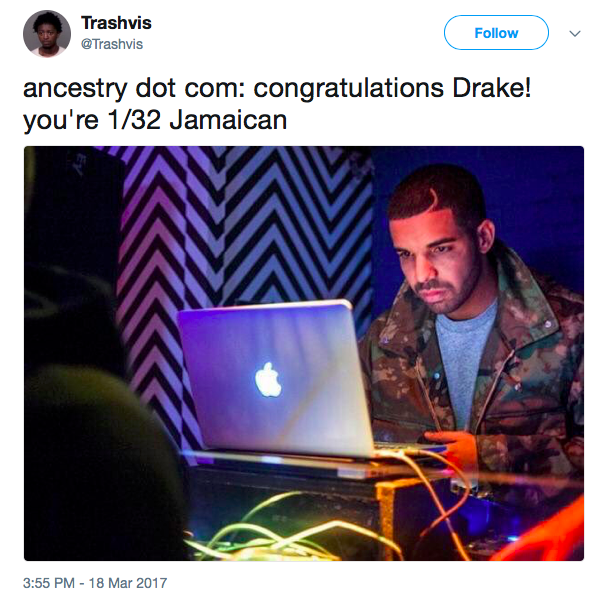
For the meme in my featured image it shows a picture of the Canadian Rapper Drake, checking a laptop. The caption for the meme is “ancestry dot com: congratulations Drake! you’re 1/32 Jamaican.” While it is unknown whether or not the creator of the meme is actually a native Jamaican Creole speaker, the meme creator does police who can and cannot use the language with the meme. It calls into question the authenticity of Drake’s continued use of Jamaican Creole in his music. The creator of the meme feels that since Drake is not of Jamaican descent, he shouldn’t be allowed to use the language. This is why he makes Drake have a tiny bit of Jamaican in him with the meme going hand and hand with the website ancestry.com. It also makes fun of the fact that people do ancestry tests, and end up with small percentages of heritage they never thought they would be apart of. So, it makes fun of the rapper and shuns him for using a language that is part of a culture/heritage he is not apart of.
Many of the comments and reactions to the post on twitter also police Drake’s use of JC. There are comments such as this one: 
Here, one of the commenters, Miguelmeza23, makes fun of Drake with their own meme-like comment. The comment has a caption that says “Drake be like,” and shows a picture of a man wearing a Rastacap saying “If I wasn’t Jamaican, then why would I wear this hat?” It not only makes fun of the rapper for using JC, but also shows how he is in a way, appropriating the culture for financial gain and prominence among the Jamaican community. However, even with all the jokes it can be argued that the rapper Drake is in fact, helping the language gain prestige. He mingles in circles of money and power, and has become an international and national icon. The fact that he uses Jamaican Creole in his music and opens up a dialogue about the language, shows how he forces people all throughout the internet (and world) to think about the language.

